Get Full Government Meeting Transcripts, Videos, & Alerts Forever!
Get email alerts on the Corrections Earned Incentive Release topic
No spam. Unsubscribe anytime.
Minn. committee hears bill to let corrections commissioner revoke earned-release credits
Summary
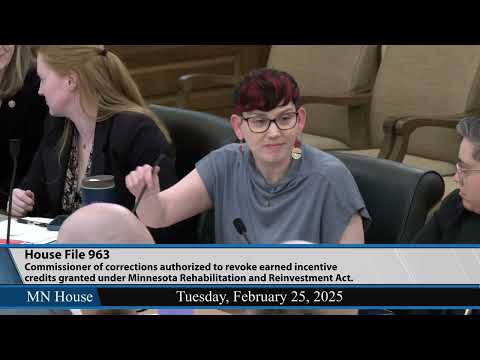
Representative Rearick brought forward legislation, House File 9 63, that would allow the commissioner of the Minnesota Department of Corrections to revoke earned incentive release credits when an incarcerated person commits severe or persistent violations.
Representative Rearick brought forward legislation, House File 9 63, that would allow the commissioner of the Minnesota Department of Corrections to revoke earned incentive release credits when an incarcerated person commits severe or persistent violations.
The bill’s sponsor said the change is intended to give the commissioner a tool to respond when an inmate already participating in programs later commits a serious offense inside a facility. "If you're going to give them time you should be able to take it away," the sponsor told the committee.
David Zimmer, public safety policy fellow with the Center of the American Experiment, testified in support, telling the committee the non‑revocable status of the current earned incentive release program "undermines the key to the whole program, incentive." Zimmer cited Department of Corrections figures presented in committee materials for 2024, including that about 6,700 inmates have a diagnosed substance‑use disorder and that the department recorded increases in assaults and contraband: inmate‑on‑staff assaults causing significant harm rose about 80 percent from 2023 and inmate‑on‑inmate assaults causing significant harm rose about 137 percent. Zimmer said those measures of disorder show the non‑revocable clause is untimely.
Paul Schnell, commissioner of the Minnesota Department of Corrections, told the committee the department already drafts policy to address the sponsor’s concern. "We don't apply those credits until they near the end of the term of their confinement or their eligibility date in accordance with MRA," Schnell said, adding the department typically seeks to make that determination about six months before an eligibility date so staff can assess recent conduct.
Committee members probed how broadly the bill would allow revocation. Representative Tabke said the phrase "violates rules of the facility" could be subjective and asked how the language would be applied in practice; the sponsor replied she intended the change to address pervasive or persistent rule‑breaking rather than isolated mistakes during rehabilitation. Representative Feist suggested tightening the language to say credits are revocable for "severe and persistent violations of the rules of the facility." Schnell and nonpartisan staff said the bill as written appears broadly drafted and that department policy already addresses many cases, but the sponsor said she wanted the change codified so it would remain if policy shifted under a future administration.
No vote was taken on the bill; the committee laid House File 9 63 over because a fiscal note had not yet been received.
Ending: The committee deferred action and will revisit the bill after the fiscal note is provided, leaving open follow‑up on statutory language versus department policy.