Get Full Government Meeting Transcripts, Videos, & Alerts Forever!
Get email alerts on the Family Community Engagement topic
No spam. Unsubscribe anytime.
Student cabinet and engagement office report finds club fairs boost student knowledge of organizing clubs; City Schools highlights test-score and graduation upt
Summary
Baltimore City Public Schools’ student CEO cabinet presented research showing club fairs increased student knowledge of how to start clubs; district leaders also reported gains on national and state recovery measures and higher graduation rates in 2023–24.
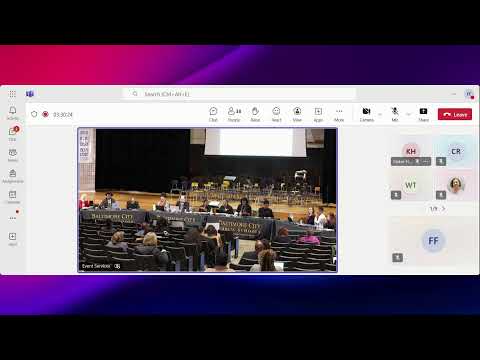
Student leaders and district engagement staff told the Baltimore City Board of School Commissioners on Feb. 25 that a district pilot of student government–led club fairs and an associated toolkit increased student knowledge about how to form clubs and encouraged participation in extracurricular activities.
Ten members of the CEO Student Cabinet presented results from a fall 2024 initiative. The cabinet awarded $800 grants to student governments that applied and hosted club fairs; after the events the share of students who said they knew how to start a club rose from 13% (pre-fair) to nearly 60% (post-fair), according to the presentation. The cabinet recommended expanding club fairs and distributing the toolkits districtwide, and asked for more administrative support at elementary and middle schools to increase participation.
Separately in the same meeting, district CEO Sonya Santelises summarized recent assessment and graduation data. The district highlighted stronger reading recovery relative to Maryland and national peers in the Education Recovery Scorecard and cited progress on math. The district also reported gains in graduation rates for 2023–24, noting a districtwide increase to 71% for the stated year and a five-year rate of 74% — the highest since 2020 — with particularly large one-year gains among multilingual learners (up 13 percentage points) and Hispanic/Latino students (up 11 points). Santelises credited investments such as literacy coaching, expanded high-quality instructional materials and credit-recovery supports for graduation-rate increases.
Presenters from the Office of Family and Community Engagement, including Tina Highcover (Chief of Communications, Engagement and Enrollment) and Vanessa Stone (Director of Family Engagement), outlined the office’s priorities: linking family engagement to learning, decision-making and advocacy, and building family/staff capacity. Highlights included expanded language-access tools (over-the-phone interpretation and multilingual “kits”), a district “Family University” to co-design workshops with families, an increase in school-based learning events supported by Title I funds (more than 180 applications this year vs. ~50 last year), and an expansion of youth ambassador and student-government programs.
Board members thanked the young presenters and engagement staff and encouraged broader rollout of the toolkits; officials said the district will support school leaders and continue to integrate family engagement into learning and budget discussions.
No formal board action was taken on the club-fair recommendations at the Feb. 25 meeting; staff asked the board to note the findings and support broader implementation through existing programs and Title I resources.