Get Full Government Meeting Transcripts, Videos, & Alerts Forever!
Get email alerts on the Public Safety topic
No spam. Unsubscribe anytime.
Klamath County approves hiring freeze exceptions to fill sheriff’s vacancies amid rising call volumes
Summary
The Klamath County Board of Commissioners approved exceptions to a general hiring freeze to allow the sheriff’s office to recruit for vacant patrol deputy posts, a school resource/KCC sergeant and a jail medical assistant following testimony about rising calls for service and staffing strain.
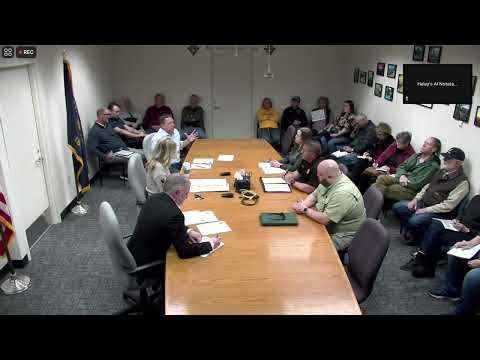
The Klamath County Board of Commissioners on Feb. 25 approved exceptions to the county’s general hiring freeze to allow recruitment for multiple positions in the sheriff’s office, citing a sharp rise in calls for service and concerns about deputy burnout and officer safety.
Sheriff Shane Mitchell told the board that recorded calls for service rose from 31,080 in 2023 to 36,350 in 2024 — an increase he described as roughly 17%. He also said January 2025 calls totaled about 5,317, compared with 4,738 in January 2023 and 4,917 in January 2024. With roughly 16 patrol deputies assigned, the sheriff said those figures equated to about 332 calls per deputy during a recent six-week period, limiting deputies’ ability to perform follow-up work.
The board approved three separate personnel actions that had been presented together during the sheriff’s office portion of the agenda: an amendment to the original request to allow posting and hiring for five vacant patrol deputy positions (the request was corrected during the meeting from four vacancies to five), authorization to post and hire for a school resource officer/Kingsley Community College (KCC) sergeant position (budgeted at about $138,000 annually, with KCC paying 75% of wages), and approval to post and hire a jail medical assistant. All three motions were approved by the board.
Why it matters: Commissioners and the sheriff framed the hires as a response to immediate public-safety strain. One commissioner described public safety as “a non‑negotiable priority” and cited ORS 368.206 as legal authority permitting use of road‑fund dollars for patrol functions. Commissioners also warned that hiring delays could lengthen the time needed to restore staffing because deputies require lengthy training and field training before operating independently.
Board discussion and context: Commissioners debated the fiscal tradeoffs of using reserve funds and road‑fund dollars for personnel. One commissioner noted that while funds exist for now, reserves used to support law enforcement reduce money available for infrastructure and other county needs; county staff projected a multi‑million‑dollar shortfall in coming years if current trends continue. Several commissioners said they are working on longer‑term funding strategies, including voter‑approved public‑safety districts, but described the hiring approvals as a short‑term “stopgap” to prevent further attrition.
Details on timelines and training: Sheriff’s staff and the undersheriff described recruitment and academy timelines during the meeting. Several recruits were scheduled to attend the academy in the weeks following the meeting, with a typical sequence of roughly six weeks in academy training and another six weeks of field training (FTO). Presenters estimated a best‑case timeline of roughly three to four months before new hires could work independently in some roles; fuller staffing for jail pods and patrol deployments was described as a target for mid‑summer, with August cited as a latest plausible date if everything proceeds normally.
Union, safety and liability concerns: Commissioners and sheriff’s office staff repeatedly cited officer safety and liability risks associated with deputies being overextended and nonmedical staff performing medical tasks in the jail. Lieutenant Strickland and other jail staff argued that filling the jail medical assistant role was necessary to reduce legal and health risks and to prepare for planned re‑opening of additional jail pods.
What the board voted: The board recorded the motions and approved the hiring exceptions. The motion to amend the number of patrol vacancies from four to five was made on the record and the amended motion passed. The SRO/KCC sergeant internal posting and the jail medical assistant posting and hiring were each moved and approved in separate votes. The chair cast an affirmative vote and the motions passed without recorded opposing votes in the public meeting transcript.
What’s next: Commissioners said they will continue to work on longer‑term funding solutions for law enforcement, including public‑safety district proposals, while using authorized exceptions and available reserves to maintain operations in the near term.
Quotes (selected): "Public safety is a non negotiable priority," said a commissioner during the meeting, citing ORS 368.206 as authority for using road‑fund dollars for patrol functions. "Our deputies right now are getting burned out. It's hard for us to do follow‑up because we're just going from call to call to call," Sheriff Shane Mitchell said when describing recent call volumes.
Ending: The board’s immediate approvals commit the county to recruit for several sworn and civilian posts this spring. Commissioners emphasized that those hires address an urgent operational need but do not replace the need for a sustainable long‑term revenue solution to maintain personnel and infrastructure.