Get Full Government Meeting Transcripts, Videos, & Alerts Forever!
Get email alerts on the Education Funding topic
No spam. Unsubscribe anytime.
Central Falls schools report $10.7 million in active grants, highlight MLL and after‑school investments
Summary
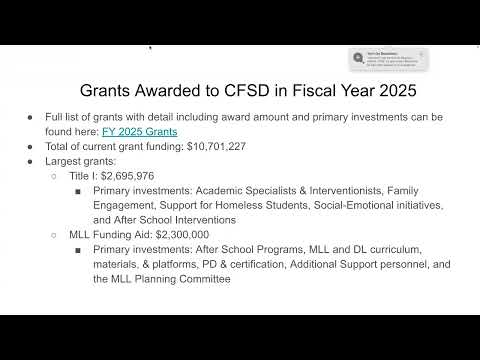
Grants lead Hannah Rivers told the Board on Feb. 25 that Central Falls School District manages roughly $10.7 million in active grant funding for FY25, with multilingual learner (MLL) aid and Title I among the largest streams supporting instructional staff, after‑school programs and family engagement.
Hannah Rivers, Central Falls School District grants lead, told the Board of Trustees on Feb. 25 that the district currently administers about $10,700,000 in active grant funding for fiscal year 2025. "For total grant funding right now, we have $10,700,000," Rivers said during the superintendent's update.
The grant portfolio is led by Title I and MLL funding, Rivers said. Title I investments include reading specialists, interventionists, family engagement staff and McKinney‑Vento supports for students experiencing homelessness. Rivers said restorative practices and some after‑school programming also draw Title I funding.
MLL funding is the single largest category given Central Falls' student makeup. Rivers said $2,600,000 is budgeted for MLL supports, made up of state MLL funding aid and other grant sources. "Our primary investments here are after school programs ... curriculum online platforms that are designed specifically to support MLL students," she said, describing bilingual teacher aides, ESOL certification reimbursements and a new assistant director for multilingual learners that the district filled this month.
Rivers described additional grants and how they are used: IDEA Part B (just under $1 million) for special education platforms, preschool designated grants for four‑year‑old classrooms, 21st Century Community Learning Center funds for after‑school programs and Title II for instructional coaching and professional learning. She said the district invests more than $300,000 in system implementation and enhancement, and $1,200,000 in after‑school programming including community partnerships and staff salaries.
Board member questions focused on funding sources and sustainability. When asked how many grants are federally funded, Rivers said approximately 75% are federal and later referred to the spreadsheet showing $5,800,000 as federal. On sustainability and ESSER carryover, Rivers said programs the district wanted to continue after ESSER were sustained through other grants and local partnerships, including expanded MLL funding.
The presentation included program participation counts for several after‑school offerings: Rivers said the C to 3 blended MLL program had 176 students with 34 staff; Project Goal (a soccer‑and‑academics program) had 113 students with 15 staff; Providence County Wrestling Club had 69 students with seven staff. Rivers and staff said those enrollments exceeded expectations and helped boost attendance.
District leaders said they will bring proposals during FY26 budget discussions to sustain programs that were supported by temporary grants. The board received the grant overview as an informational update; no separate vote was required on the grant summary itself.