Get Full Government Meeting Transcripts, Videos, & Alerts Forever!
Get email alerts on the Landscape Maintenance Districts topic
No spam. Unsubscribe anytime.
Oxnard committee opens policy workshop on landscape maintenance districts amid complaints of underfunding and high administrative costs
Summary
The Public Works and Transportation Committee discussed a draft framework for a maintenance and funding policy covering Oxnard's 36 landscape maintenance districts, focusing on underfunded districts, reserve rules, Proposition 218 balloting and possible service reductions. Staff will prepare a draft policy for committee review.
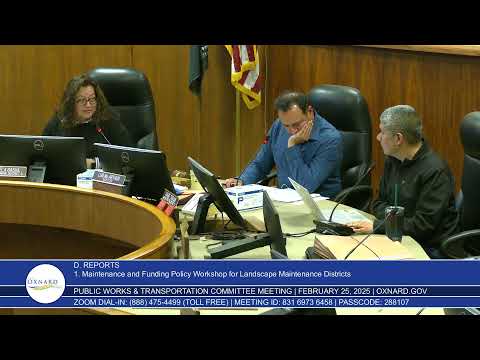
The Public Works and Transportation Committee of Oxnard City held a workshop Feb. 25 to discuss a potential maintenance and funding policy for the city’s 36 landscape maintenance districts, focusing on options for underfunded districts, reserve guidelines and the process to request new rates under Proposition 218.
Anthony Miller, the city’s special districts manager, told the committee the item is intended to outline policy-level questions the city council might direct staff to adopt and to avoid repeating past management problems. “This does not address any other district other than landscape maintenance districts,” Miller said, noting the presentation was framed as seven policy questions staff commonly confront in managing 1972 Act LMDs.
The seven questions presented to the committee asked how the city should respond if district expenses exceed available revenue; how to address negative fund balances; whether LMDs should be required to meet a reserve target; who may request a Prop 218 ballot; how the city should process and pay for rate changes; whether subsidies are allowable; and what happens if a district chooses not to ballot.
Miller and other staff members outlined typical policy options: use reserves where legally allowed, reduce routine services, apply a maximum levy where permitted, conduct outreach to gauge interest in a Prop 218 ballot, remove improvements that are general rather than special benefit, or follow other council direction. Staff said those are examples, not required outcomes, and that the city’s legal consultant is available for statutory interpretation.
Residents and neighborhood representatives pressed the committee for different remedies. Doug Portello, a 38-year Oxnard resident and founder of Oxnard Grassroots Volunteers, criticized LMD management and administrative fees and urged large-scale changes: “The landscape maintenance districts have been a complete disaster for the longest time,” Portello said. He recommended dissolving districts or returning decisions to voters once homes are occupied, and argued the city should cover maintenance out of the general fund rather than rely on small homeowner assessments.
Other residents described maintenance shortfalls. Ray (surname Patel) and Imelda Garcia Ramirez told the committee that some neighborhoods see infrequent landscaping, overgrown shrubs and illegal dumping in poorly maintained parkways. Debbie Mitchell, representing the Mandalay LMD, said a pending state permit for a Hemlock seawall project has delayed required engineering work that would allow her district to pursue a bond or ballot to cover needed seawall repairs; until that project is resolved, Mitchell said, the district cannot complete the engineering documentation needed to seek a rate increase.
Legal and technical constraints surfaced repeatedly. Mark Mandel, the city’s legal consultant, summarized the Prop 218 balloting process: ballots are mailed to property owners in the district, votes are weighted by assessment amount, and the increase must secure more yes-weighted ballots than no to pass. A caller who identified herself as Alicia warned the committee about strict limits in the Landscaping and Lighting Act of 1972 and the Streets and Highways Code on permissible uses of LMD funds and on multi-year reserves, and noted previous litigation over use of LMD funds for outreach.
Staff provided data and clarifications during the discussion: the city currently manages 36 LMDs; one district had a negative fund balance at the time of the meeting, 11 LMDs have capped inflators (limiting automatic rate increases), and 22 LMDs have capped utility allocations. Miller said staff’s internal operating cash-flow goal for a district is roughly 47.4% to cover the gap until the first property tax disbursement of the fiscal year, but acknowledged that making that a mandatory requirement would complicate budgeting for districts with capped rates. The city manager and staff also estimated—very roughly—that dissolving and shifting all LMD landscaping to the general fund could create a multi‑million dollar annual cost (staff gave a rough order-of-magnitude of about $3–4 million for landscaping alone), though any actual impact would depend on service levels and district-by-district decisions.
Committee members pressed staff for outreach and greater transparency. Several members asked for a standing five- to seven-year outlook for each district and annual notices to affected property owners explaining anticipated service levels, reserves and the consequences of a failed Prop 218 ballot. Multiple council members said they were reluctant to use the city’s general fund as an automatic subsidy and characterized such a move as a last-resort option because it would shift costs to taxpayers across the city, including neighborhoods that do not have LMDs.
Staff and legal counsel described the practical mechanics of a Prop 218 increase and options to gauge support before formal balloting, including resident-led petitioning or staff-conducted outreach. Michael Wolf and Miller said staff have used a model in other cities where early outreach and then demonstrable service reductions after an initial failed ballot helped produce later successful ballots when property owners saw the consequences of a no vote.
After roughly two hours of discussion and public comments, committee members agreed staff should prepare a draft policy informed by the meeting and return it to the committee for additional review before the full City Council considers it. The committee voted 3–0 to direct staff to return with a draft for further committee review.
Votes at a glance - Approval of consent minutes (Feb. 11, 2025): motion to approve minutes as presented—vote recorded as Committee member Teran: yes; Committee member Basuah: yes; Chair McArthur: yes. Outcome: approved, 3–0. - Direction to staff to prepare draft policy and bring it back to committee: motion to have staff return with a draft—vote recorded as Committee member Basuah: yes; Committee member Teran: yes; Chair McArthur: yes. Outcome: approved, 3–0.
What’s next Staff will prepare a draft maintenance and funding policy for landscape maintenance districts that incorporates the committee’s input and public comments and will return to the Public Works and Transportation Committee for further review before the item is scheduled for City Council consideration.