Get Full Government Meeting Transcripts, Videos, & Alerts Forever!
Get email alerts on the English Learners topic
No spam. Unsubscribe anytime.
District partners with Harvard fellowship to evaluate English learner programs; recommends standardization and site-based EL specialists
Summary
A district staff member selected for Harvard's Strategic Data Project presented a three-year English Learner program evaluation and recommended districtwide program guidance, data dashboards and hiring EL specialists at each site to reduce variation in pullout models and improve outcomes.
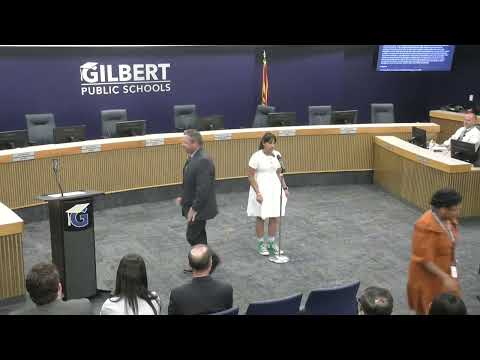
Justine Ingram, a Gilbert Public Schools staff member serving as a fellow in Harvard University's Strategic Data Project, presented the fellowship's work to the Governing Board on Feb. 25 and outlined an English Learner (EL) program evaluation that will inform a districtwide evaluation model.
Ingram said the project pivoted from a districtwide data-literacy plan to a focused evaluation of the EL program after continuous improvement meetings identified English learners as an area of need. The fellowship provided research methods training, external technical advising and networking; Ingram said she worked with a technical advisor from Boston College and district teams to develop a logic model, conduct a three-year data analysis and perform classroom observations across K'12 EL programs.
Key findings shared with the board included:
- Elementary pullout programs varied across sites; one variation showed weaker results and district teams recommended standardizing practices. Ingram said overlapping grade levels in pullout schedules reduced effectiveness and should be avoided. - Integrated instruction in general-education classrooms was more effective at sites where staff received training and follow-up. - At the secondary level, hybrid EL models (part remote/hybrid) were generally less effective than in-person models and required more training and personnel to succeed.
Outcomes and next steps: the fellowship work produced an English Learner program guide, live data-monitoring dashboards for district leaders, and a draft district program-evaluation model designed to be adaptable to other programs. Ingram described the objective as building a durable evaluation process so the district "doesn't have to have a lengthy program evaluation in the future" and so leadership can monitor EL metrics in near-real time.
Board members asked about specific improvements identified. Ingram and coordinator Tina Wenning said recommended changes include avoiding overlapping grade-level pullouts, increasing professional development for staff who provide integrated instruction, and creating EL specialist positions at each middle and high school site where feasible. In response, a board member said they hoped the district would move toward stationing EL specialists at every site.
What happens next: the EL program evaluation will continue through September under the Harvard fellowship timeline and district staff said they will refine the district program-evaluation model and data dashboards for broader use across other district programs.
Votes and formal action: This item was presented as an academic spotlight and no board action was required.