Get Full Government Meeting Transcripts, Videos, & Alerts Forever!
Get email alerts on the City Budget Finance topic
No spam. Unsubscribe anytime.
Finance committee reviews FY25 second-quarter finances, flags ongoing deficits and downtown parking shortfall
Summary
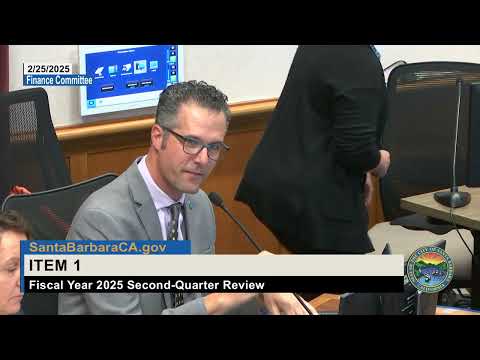
Santa Barbara City Finance Committee Chair Friedman on Feb. 25 received the city’s second-quarter financial review for fiscal year 2025 from Finance Director Keith DeMartini and the city controller.
Santa Barbara City Finance Committee Chair Friedman on Feb. 25 received the city’s second-quarter financial review for fiscal year 2025 from Finance Director Keith DeMartini and the city controller.
DeMartini told the committee that after six months of actual data staff projects the general fund will end FY25 with an approximately $7.2 million deficit, improved from a budgeted $9.9 million shortfall that assumed a $3.2 million contribution to reserves. “When you include … our reserve policy, you will see that we have had operating deficits for the last couple of years, and we are projected to do so again in fiscal year 2025,” DeMartini said.
The presentation included the staff multiyear forecast showing a continuing structural imbalance but a one-year improvement in FY26 tied to Measure I, the voter-approved sales tax increase. DeMartini said the FY25 projection includes three months of Measure I revenue and that FY26 shows a projected $3.3 million surplus driven by a full year of that revenue. He also clarified that the forecast does not include any additional costs that might result from a separate class-and-comp study; those costs would be added later if adopted.
Controller Natalie Licoli summarized department-level spending and enterprise fund performance. She reported sales tax collections are running below budget and that transient occupancy tax (hotel tax) was tracking above last year’s comparable period. On enterprise funds, staff reported the water enterprise had collected roughly $42.5 million to date (about 53% of its budget) and that expenses were affected by the desalination plant being offline from August to December. Clean Energy showed a $2.5 million loss at the end of Q2; staff said a midyear 12% rate decrease by Southern California Edison reduced benchmarked revenues. The airport was near neutral for the six-month mark, with a 15% rise in passenger counts from the prior-year period but with expected year-end reserve use tied to unplanned generator repairs.
Committee members pressed staff on a few implications. Chair Friedman asked whether the FY26 projected $3.3 million surplus includes the class-and-comp study; DeMartini said it does not. He also asked whether a proposed contribution to a local housing trust fund is reflected; staff said no transfer is assumed in the current projection and that any such appropriation would reduce the projected FY26 surplus.
Members asked about Measure C (the capital-project sales tax). Staff said Measure C receipts are softer than expected and that while there is currently no cash-flow problem for in-flight projects, the council will need to consider which capital projects to appropriate next year if the soft trend continues. Downtown parking was singled out: staff reported downtown parking revenue and outdoor facility rent are underperforming and projected a FY25 shortfall the presentation quantified as about $3.6 million, with an operational decrease in reserves of about $3.3 million. Staff noted the council previously approved using Measure C revenue for some downtown parking capital projects, which places additional pressure on general-fund resources.
On the consent-calendar budget adjustments, staff listed a proposed increase in appropriation to a police station capital fund funded from revenue bond proceeds to cover station construction costs, and a requested reduction in estimated downtown parking revenue of $2.5 million tied to an on-street paid parking program that was not approved by council in the adopted budget.
After questions and brief comments of appreciation for the detailed briefing, Committee Member Hardin moved to adopt the staff recommendation to receive the Q2 materials and forward the proposed amendments to the council; Member Sanrio seconded. The committee voted unanimously to approve the staff recommendation.
The committee will forward the recommended Q2 budget adjustments and the proposed amendment to the city’s position-salary control resolution to the full City Council for action later the same day.