Lawton Water Authority presents 20-year water/wastewater plan; study recommends rate changes and authority seeks EPA grant
Loading...
Summary
Friese & Nichols presented a 20‑year water/wastewater cost‑of‑service study to the Lawton Water Authority and City Council on Feb. 25 that identified multi‑million‑dollar shortfalls and recommended rate changes projected to produce about $5 million of additional revenue in FY26; the authority and council accepted the report but deferred any immediate residential rate vote.
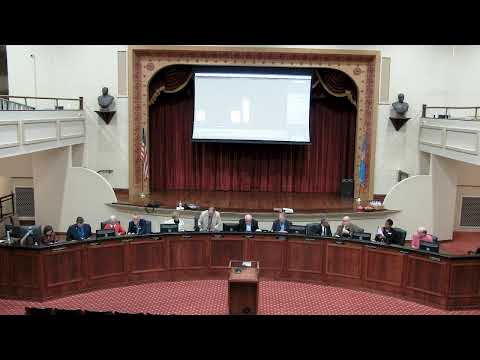
Consultants for the Lawton Water Authority presented a 20‑year water and wastewater cost‑of‑service study at the Feb. 25 joint meeting, laying out projected operating and capital needs and a recommended multi‑year rate plan. Friese & Nichols told the authority the system faces an approximate $2 million shortfall on the water side and a roughly $3 million shortfall on the sewer side for fiscal year 2026 under current rates; the consultants proposed rate changes intended to raise about $5 million in the first year to address the gap and to begin funding planned capital renewal.
The authority and council discussed the study at length but took no immediate action to adopt residential rate increases. Instead the city acknowledged receipt of the study and held a wide-ranging discussion about the authority’s historic transfers to the general fund and options for funding system renewal.
Key findings and proposal - Revenue gaps: Friese & Nichols reported projected FY26 revenues at current rates of about $19.6 million (water) versus a $21.6 million cost to operate — a nearly $2 million gap. For sewer, the firm reported projected revenue of about $10.4 million versus $13.3 million in costs — a gap near $3 million. The combined first‑year revenue shortfall under current rates would be addressed by a recommended set of rate increases projected to produce roughly $5 million in additional annual revenue in FY26. - Rate design: Consultants recommended holding base monthly fees steady (each base includes 2,000 gallons of water) and increasing volumetric rates across customer classes. The study also recommended creating a separate industrial customer class (below current nonresidential rates) to reflect different use and to support economic development efforts; existing negotiated contracts (Fort Sill, Goodyear, Republic) remain in effect and were modeled as contract revenues. - Capital plan: The study includes a long‑range investment schedule with phased borrowing beginning in FY27 for plant upgrades and later pipeline work starting around 2029. Consultants noted the system’s current low level of operations-and‑maintenance spending (per customer) relative to peers and said that historic transfers out of the utility to the general fund have constrained reinvestment.
Council and authority reaction - Transfer vs. rates debate: Multiple council members and the chair of the authority pressed on how much of the funding gap results from direct transfers to the general fund versus from underpricing of water and sewer service. Mayor Stan Booker and other members said the city has historically transferred enterprise funds into the general fund, reducing funds available for reinvestment. Several council members urged further study and coordination between the city and the authority before approving rate changes. - No immediate residential rate vote: Council members said they wanted more fiscal detail before voting on residential increases and noted an upcoming analysis (the Crawford/Hatch benchmarking update was referenced) that they wanted to review. Several members suggested alternatives such as reducing transfers to the general fund or phasing changes, and asked staff to model those options.
Grant actions - EPA communities grants: The Lawton Water Authority reported it has been preselected for federal communities grants that were secured through the congressional appropriations process. An appropriated amount of $5,125,000 remains available to support construction of a sludge‑handling facility at the Southeast Water Treatment Plant. The authority voted to authorize its chair to sign the grant applications and related documents; motion carried 7–0. The city council approved a companion resolution authorizing the mayor and city clerk to sign required documents; the council vote was 8–0.
Direct quotes - Cara Sheror, Friese & Nichols (consultant): “This is a reflection of some of the key areas of the water and sewer funds … we’ve got an increase of about $1,400,000 over those two years on water operations and maintenance expense.” - Mayor Stan Booker: “I wish we’d have had this 20 years ago.” Booker and other council members framed the conversation as partly a choice between raising rates and reducing transfers to the general fund.
Next steps The authority and council accepted the study for consideration and asked staff to return with models that show alternatives (for example, lowering transfers to the general fund or phasing increases) and the financial impacts of those options. The authority and council also approved moving forward with the EPA grant application process; if awarded, the $5,125,000 appropriation will fund construction of the recommended sludge‑handling improvements at the Southeast Water Treatment Plant.
Ending City staff and consultants will produce scenario models at council direction and provide updated budget and transfer proposals; any formal rate ordinance would require a separate public hearing and council action before changes take effect.