Get Full Government Meeting Transcripts, Videos, & Alerts Forever!
Get email alerts on the Ai In Cities Toolkit topic
No spam. Unsubscribe anytime.
Commission reviews ‘AI in Cities’ toolkit; members point to pothole and asset‑management pilots as immediate use cases
Summary
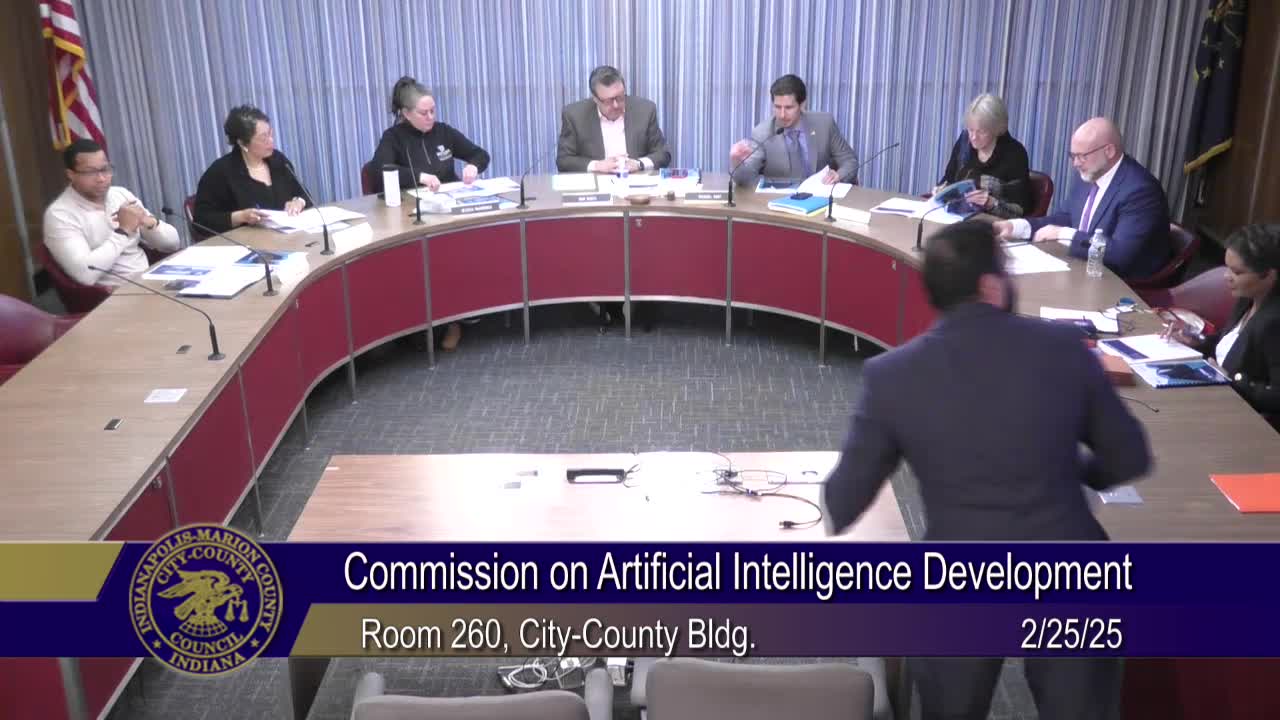
Vice Chair Michael Paul Hart told the commission that the National League of Cities’ AI in Cities toolkit affirms local plans and showcases municipal pilots such as Memphis’s pothole detection work; commissioners discussed promising use cases and barriers including culture change, privacy and political considerations.
Vice Chair Michael Paul Hart briefed the commission on the National League of Cities’ AI in Cities reporting toolkit and said it largely affirms the commission’s current work on data governance, role definitions and use‑case vetting.
Hart highlighted municipal examples in the toolkit and singled out Memphis’s AI project to detect potholes and property blight as a model with relevance to Indianapolis. “The 1 that that really stood out to me the most… Memphis has implemented an AI solution to address potholes and and property blight,” Hart said, adding that those are routine constituent concerns for local councilors.
Hart said the toolkit endorses common preparatory steps—data readiness assessments, role assignments, public engagement and pilot testing—and also catalogues barriers to adoption such as culture change, political considerations and privacy concerns. Commissioners observed that many of those challenges appear in local discussions and that the toolkit includes a practical toolkit for cities to run readiness surveys and develop policy templates.
Commission members discussed local equivalents: the city already captures street‑condition data through PCI drive surveys; members saw potential for enhanced automation and image analysis to increase efficiency. Commissioners also noted snow‑removal and translation services as lower‑risk initial use cases and debated where the commission should focus between setting enterprise architecture and promoting pilot projects within departments.
The commission agreed to continue mapping local use cases to city operations and to convene functional user groups to surface department‑level opportunities and concerns. Colin Hill, the CIO, was asked to synthesize key barriers into an internal checklist for departments to follow when proposing pilots.
Hart recommended making the toolkit available to departments for reference and suggested follow‑up outreach to the Memphis program to learn implementation details.
(Reporting note: use‑case descriptions and barriers are taken from the commission discussion and the cited AI in Cities toolkit as discussed by Vice Chair Hart.)