Get Full Government Meeting Transcripts, Videos, & Alerts Forever!
Get email alerts on the Sfmta Finances topic
No spam. Unsubscribe anytime.
SFMTA warns of growing budget gap; seeks mix of cuts and new revenue ahead of 2026 funding cliff
Summary
SFMTA Director Julie Kirschbaum told the SFCTA board Feb. 25 that one‑time federal and state aid is being spent down, leaving an estimated $50 million shortfall for FY2025–26 and a roughly $320 million structural gap beginning FY2026–27; the agency is weighing service cuts, tapping reserves and participation in a regional ballot measure.
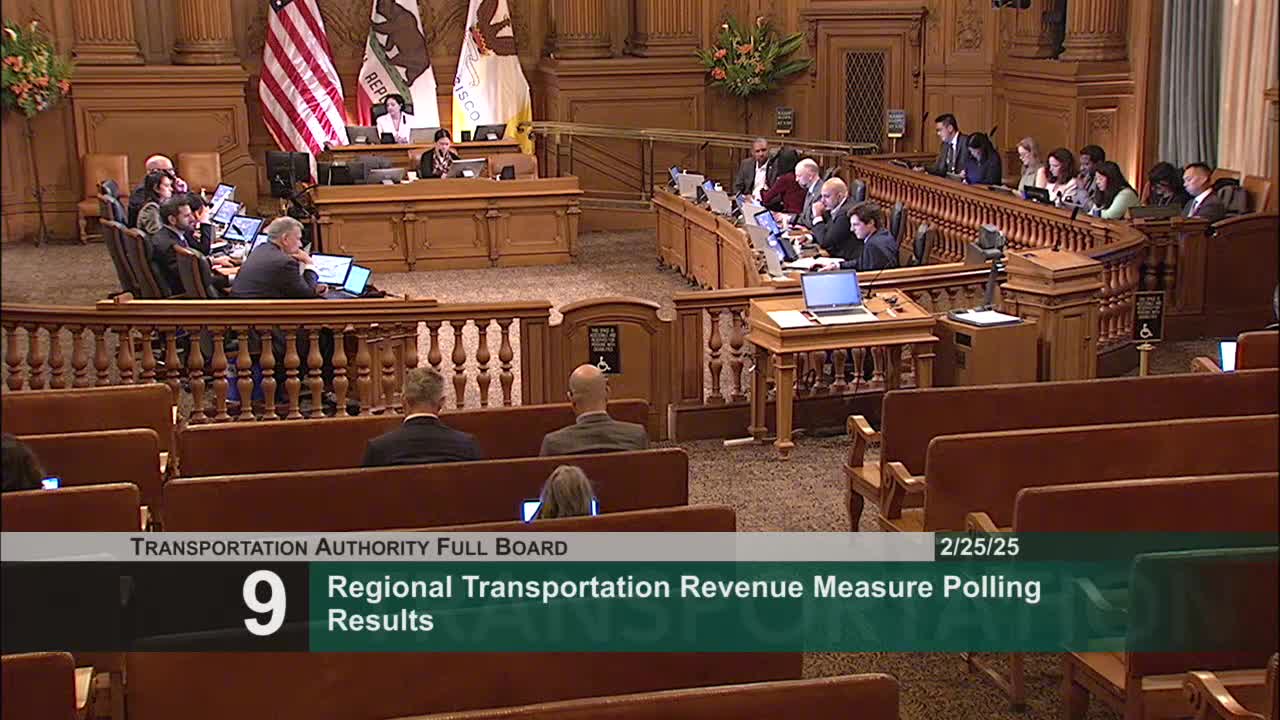
Julie Kirschbaum, the newly appointed director of the San Francisco Municipal Transportation Agency, told the San Francisco County Transportation Authority on Feb. 25 that Muni and the region face a funding cliff when one‑time federal and state relief dollars are exhausted.
“We are anticipating about a $50,000,000 need” for fiscal year 2025–26, Kirschbaum said, and “when the one‑time money is exhausted starting in summer of 2026, it’s about $320,000,000.”
Why this matters: Muni carries roughly half of Bay Area transit trips; shortfalls at Muni and other operators could translate into service cuts, fare or parking changes, or new taxes to sustain service levels.
Kirschbaum outlined a set of short‑ and longer‑term responses. In the near term the agency expects to close much of the FY25–26 gap with a mix of measures including hiring freezes, reallocation of some one‑time city general‑fund resources, optimization of fare collection and parking revenue, and reductions in professional services and capital timing. The agency estimates roughly $35 million of actions that can be achieved with “relatively modest changes” and another $15 million that would require harder tradeoffs.
On longer horizons, Kirschbaum said the SFMTA is working with the Mayor’s office, the controller and the Muni funding working group to prepare packages that mix revenue and spending options. She told the board the agency will likely participate in the regional ballot effort discussed elsewhere in the meeting and also expects a complementary city‑level package may be necessary.
Kirschbaum described improvements in operations and fare collection that have helped revenue in the near term: stronger fare enforcement, better customer information and steps to increase ‘‘tagging’’ when the Clipper upgrade is implemented. She also highlighted weekend ridership recovery and targeted quick‑build projects — for example, a boarding island near Balboa Park Station and Vision Zero pedestrian bulbs funded with Proposition AA vehicle registration fee and sales tax funds.
Garage revenue has been a particular pressure point. Kirschbaum said downtown facilities such as the Fifth and Mission garage have seen dramatic declines relative to pre‑COVID receipts; she cited a prior high of about $25 million and a current forecast of roughly $9 million for that facility.
The SFMTA board asked staff to refine options and return with two specific proposals: one that combines program cuts and a reduced level of service reductions, and a second that avoids summer service cuts by tapping reserves. The board had previously directed staff to avoid eliminating the crossing‑guard program.
Kirschbaum said the SFMTA anticipates presenting refined options to its board on March 18, and that further San Francisco‑specific polling will be conducted to inform the shape of any local measure.
Sources: Presentation by Julie Kirschbaum and SFMTA staff to the San Francisco County Transportation Authority, Feb. 25, 2025.