Get Full Government Meeting Transcripts, Videos, & Alerts Forever!
Get email alerts on the Workforce Local Hiring topic
No spam. Unsubscribe anytime.
SFPUC says local-hire policies drove millions in wages, increased contracts for local businesses
Summary
SFPUC staff told commissioners the agency’s local-hire and local-business requirements produced measurable outcomes on major capital projects, including wage and contract totals, apprentice participation and project-specific local participation gains.
The San Francisco Public Utilities Commission reported substantial local hiring and local business participation on its capital projects, saying the agency’s contracting and workforce programs directed millions of dollars in wages and nearly a billion in local contract awards back into the San Francisco economy.
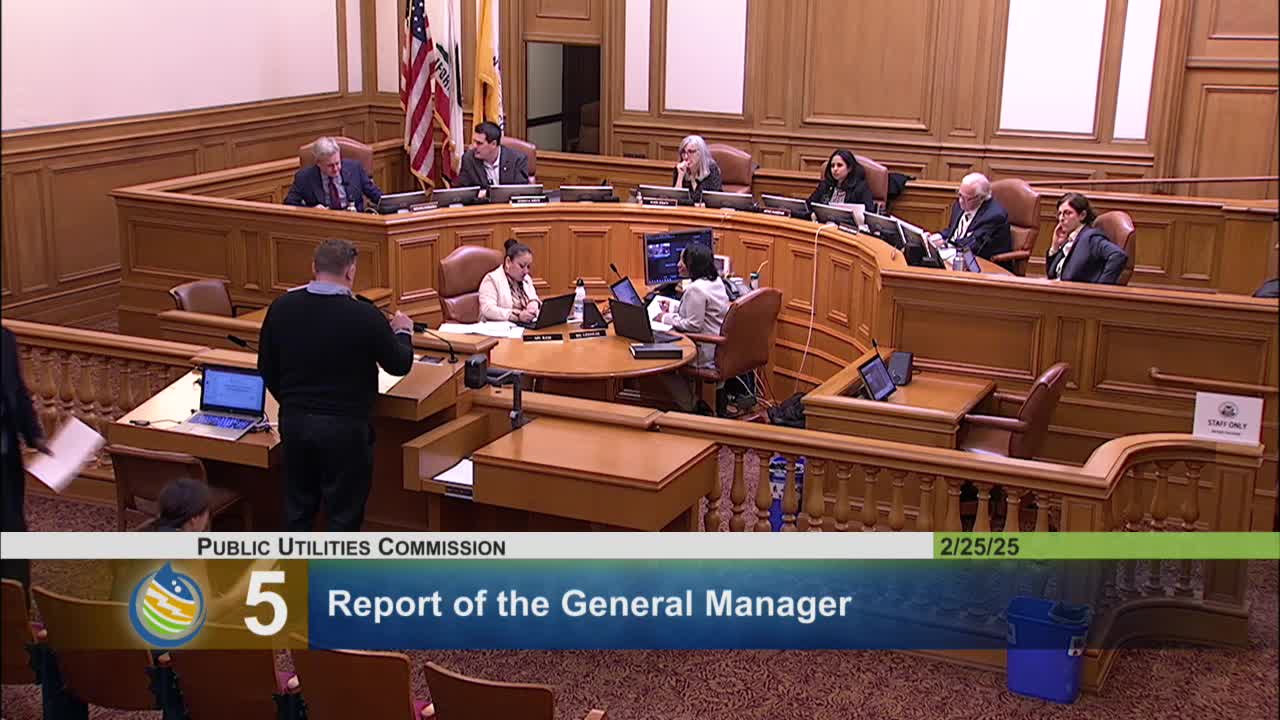
The report, presented at a regularly scheduled SFPUC commission meeting by Ben Poole, director of workforce and economic program services, and Wendy Macy, chief people officer, summarized data through Dec. 31, 2024 and highlighted results from the Sewer System Improvement Program and large projects including Mountain Tunnel, Biosolids and Headworks. "We focus on workers that can be on our construction projects, or professional services contracts and on small businesses that can be on those projects as well," Poole said.
Poole told commissioners that San Francisco residents earned about $110,000,000 in wages and benefits on the Sewer System Improvement Program and that the program has awarded roughly $862,000,000 to local business enterprises (LBEs) across many contracts. He said apprentice participation and local-hire percentages exceed many statutory requirements: the program overall is at 34% local hiring and 57% local resident apprentices on applicable contracts, above the 50% apprentice target cited for some projects.
The presentation cited project-level results: Biosolids has accounted for roughly $400,000,000 in awards to LBEs and Headworks about $105,000,000. Poole called out the Southeast Community Facility project at 1550 Evans as an example of targeted local participation: the project exceeded a 20% LBE requirement with final LBE participation of 31%, and San Francisco residents performed roughly 39% of work hours, with about 35% of resident hours from District 10.
Macy described SFPUC human-resources outreach and recruitment steps intended to convert project work into permanent agency jobs, including a community career fair planned for April at the Southeast Community Facility and use of online talent platforms. "We also are announcing a community strong career fair in April, which is gonna be held at our Southeast Community Center facilities in the Bayview," Macy said. Recruiter Vincent "Olu" Olumayoku Fadenipo told commissioners the agency is engaging community colleges and universities to strengthen pipelines and help applicants understand the hiring journey: "my heart is to align with individuals and meet them where they are."
Commissioners pressed staff for definitions and scope. Commissioner Leberone asked whether "local" meant San Francisco residents or a wider service territory; Poole said definitions vary by project. He explained Mountain Tunnel uses a regional definition tied to the agency’s service territory ZIP codes, which increases local participation numbers for that project. Commissioner Jamdar asked whether "resident apprentices" only includes registered union apprentices; Poole said yes, those figures come from the city's LCB (local compliance/benefits) tracking system and count indentured apprentices only. Poole also acknowledged one project where apprentice participation was below the requirement and said Office of Economic and Workforce Development (OEWD) compliance processes can adjust final figures.
Commissioners and staff described the contracting tool the agency calls "local participation," which asks prime contractors to map scopes, timing and the market and to supply plans where gaps exist. Poole said that approach worked well on the 1550 Evans project where primes and trade partners trained and bid specific scopes to increase small-business and apprenticeship participation.
Advocates and commissioners framed the programs as economic-development tools and ratepayer investments. Commissioner Arce, who toured Mountain Tunnel and Moccasin, praised the long-term effect of mandatory local hiring and project labor agreements in producing higher local and apprentice participation compared with past practice. "It's really impressive to see what you and the team have done with with these policies over the last, what, 10 years at this point," Arce said.
The presentation and question-and-answer period did not include any formal vote; staff offered to provide printed resources about contractor assistance, CityBuild referrals, and contract-monitoring contacts for businesses and workers seeking to participate.
Ending: Staff said the data presented are calendar-year 2024 totals and that programs will continue to be refined; commissioners asked staff to share the OEWD and contractor-assistance contact materials and to follow up on hyperlocal definitions and the apprentice shortfall on Headworks.