
Guadalupe County discusses $505,000 design proposal for North Guadalupe Street ahead of EOC project
Get AI-powered insights, summaries, and transcripts
Sign Up Free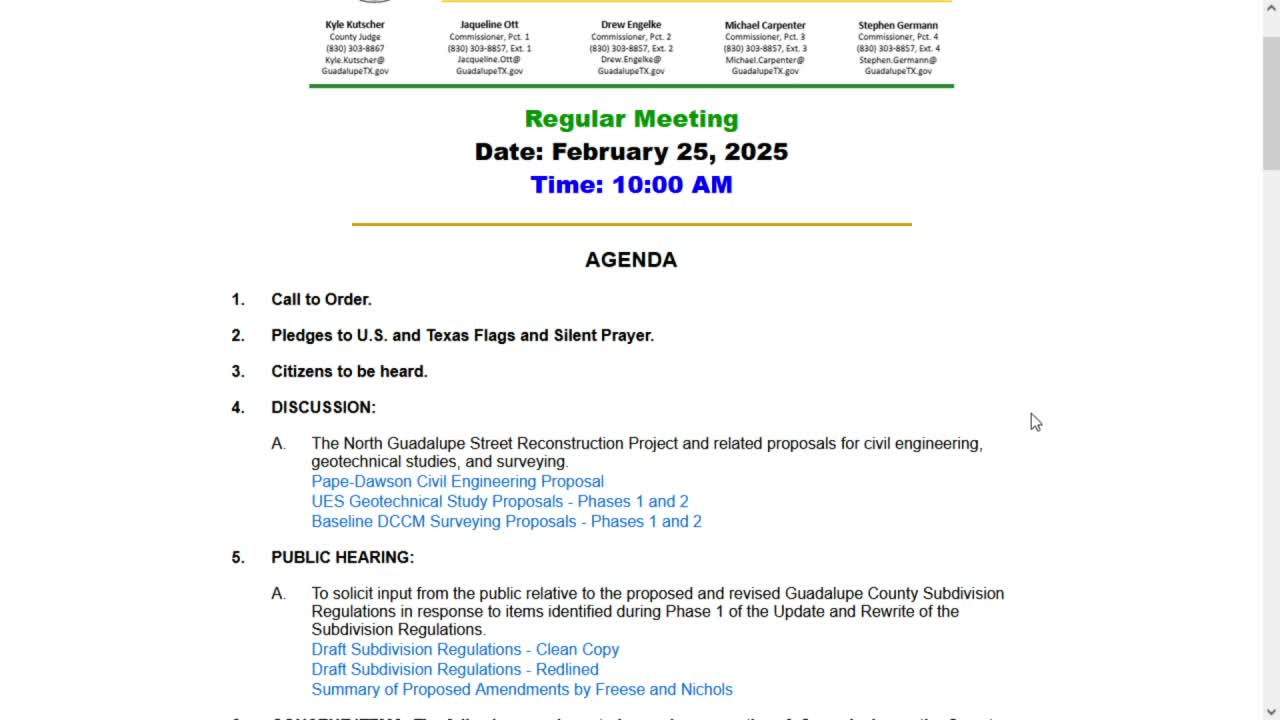
Summary
County officials reviewed engineering, geotechnical and survey proposals for a phased rebuild of North Guadalupe Street tied to the Emergency Operations Center project and other county facilities, and asked staff to return with refined construction cost estimates.
Guadalupe County officials on Feb. 2025 discussed proposals to design improvements to North Guadalupe Street so planned county projects — including an Emergency Operations Center, an animal-control expansion and storage facilities — can move forward.
The court reviewed an engineering package from Pape Dawson that would study and design the corridor in phases, and separate the roadway improvements from the county’s building projects so construction can proceed without delaying ARPA-funded building work. "The city is requiring us to be a corridor, from Strimple Street all the way to Interstate 10," Patrick Pinder said while showing a map of the county-owned property and the proposed work. He described the proposals as three separate tasks: civil engineering, geotechnical studies and surveying.
County leaders and staff discussed timing and costs. Pinder said the immediate design-phase costs for the preferred approach are roughly $141,000 for engineering, about $82,500 for geotechnical work and $31,000 for survey; he gave an overall design estimate of $505,004.85 to cover both phase 1 and phase 2 design work. He emphasized the quoted costs were for design only and that construction would require a separate bidding process or be done by the county’s road-and-bridge crews.
Commissioners and staff also discussed whether the county must deliver the entire roadway improvement at once. Commissioners noted the city of Seguin has signaled that construction and roadway approvals are typically coupled: "It’s supposed to run together and be completed at the same time, but that would be an agreement between the commissioner's court and the city," Pinder said. Court members said their priority is to avoid delaying the EOC construction because ARPA grant spending must be completed by the end of 2026.
Officials described two paths: 1) present a phased design and seek city permission to start the building project while later phases of roadway work are completed; or 2) design the full corridor now so the county can build a more substantial thoroughfare that would serve long‑term county operations but with higher near‑term costs. Commissioners noted a full build could be multimillion-dollar work: Pinder and the judge warned an expanded, hardened corridor suitable for future thoroughfare traffic could cost in the low millions to multiple millions of dollars depending on scope.
The court did not approve contracts at the meeting. Instead commissioners instructed staff to gather construction-cost estimates for the two principal cross-section options — the city-required standard and a wider, turn-lane configuration the county has discussed — and to return with numbers for phase 1 construction and the full corridor. "Let's do a little bit more homework. We'll try to get some proposed numbers on phase 1 construction cost and the roadway in its entirety in two different designs," the judge said near the end of the discussion. The court also asked staff to explore whether to use Pape Dawson or run a qualifications process for roadway engineering services.
The discussion included logistics the court will need to resolve with the city, such as right-of-way dedication, relocation of a radio tower and whether the county will relocate existing bail-bond and other private properties that sit along the corridor. Commissioners said they preferred doing the work once and to a standard that will not need early replacement, but acknowledged budget constraints and competing county priorities.
The court expects staff to return with construction estimates, timing for city agreements, and recommendations on whether to award design contracts now or seek other engineering firms before proceeding to a formal contract approval.
Ending: The county emphasized phasing design work to protect ARPA-funded building timelines while pursuing longer-term corridor upgrades, and directed staff to report back with construction cost estimates and procurement options before committing to design contracts.