Get Full Government Meeting Transcripts, Videos, & Alerts Forever!
Get email alerts on the Community Gardens topic
No spam. Unsubscribe anytime.
Commissioners back study of community garden in Cooper City, ask for blueprint and volunteer plan
Summary
After discussion about volunteer management, easements and food access, the commission gave consensus to advance a community-garden concept and asked the sponsoring commissioner to return with a detailed plan showing location, volunteer structure and logistics.
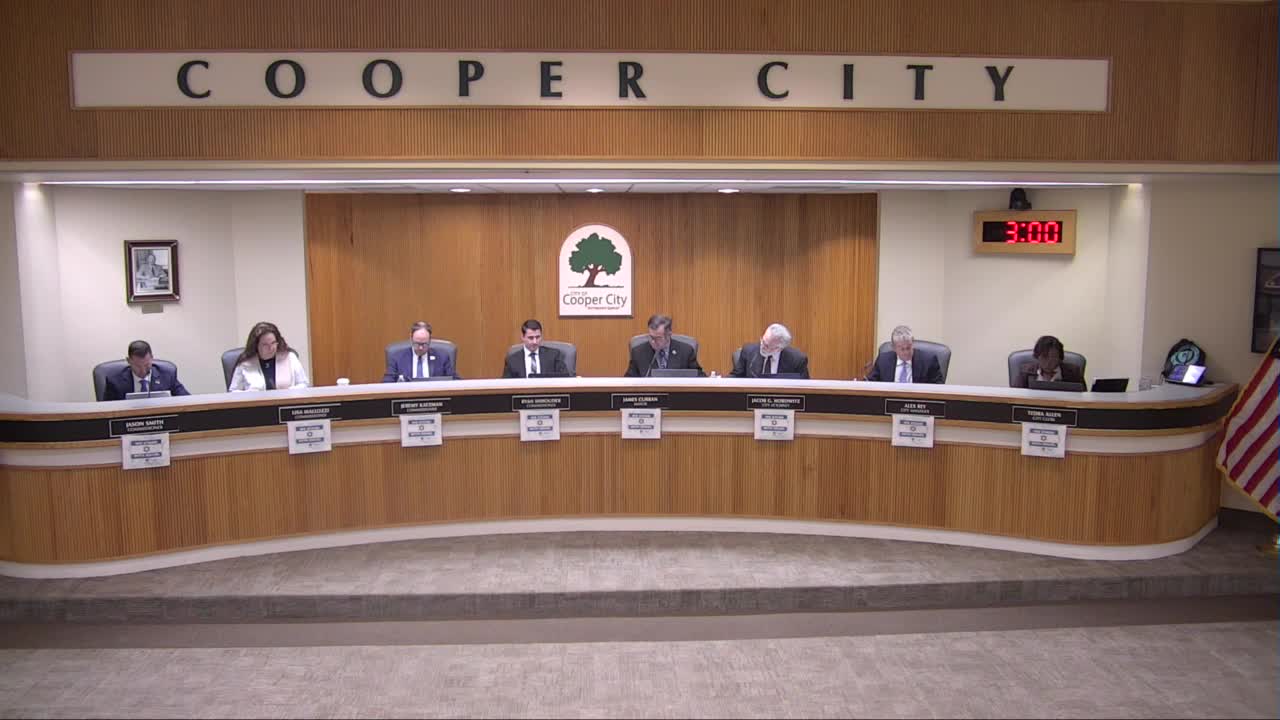
Commissioner Lisa Mallozzi opened a discussion on a proposed community garden for Cooper City, and the commission agreed on a next step: bring back a detailed blueprint, a volunteer-management plan and a recommended site for consideration.
Why it matters: The proposal aims to provide educational opportunities and supplemental food for residents while creating a community amenity. Commissioners emphasized starting small, avoiding city staff maintenance obligations and coordinating with utility easement holders.
Discussion and direction Commissioner Lisa Mallozzi said she had researched programs in other Broward County municipalities and envisioned a small, raised‑bed garden (she cited a 30-by-110-foot example in Pembroke Park) that could be run by volunteers and school environmental clubs. “Start small and work our way,” Mallozzi said, adding that volunteers could take first priority on harvested produce and that some residents are “food hungry” despite living in an affluent area.
Commissioner Schroeder and others raised two recurring concerns: long-term maintenance when volunteers wane, and whether the city has staff capacity to run the site. Schroeder said the biggest issue she’s seen in other cities is the program falling off and then becoming a city responsibility. Mallozzi said she did not intend to use city staff for ongoing maintenance and had already discussed the concept with the Green Advisory Board, which was supportive.
Commissioner Katzmann and others suggested partnering with existing school environmental clubs or community partners such as Feeding South Florida and the Senior Advisory group to maximize reach and avoid duplication of effort.
Easement and location constraints Mallozzi said she had preliminary permission from FPL to use an easement under power lines in the Monterra area but acknowledged the city would need to confirm exact placement and comply with FPL restrictions (for example, avoiding planting large trees under lines). Commissioners asked staff to coordinate with residents and property contacts to identify suitable locations that would minimize traffic impact and preserve safety.
Next steps and staff role The commission did not adopt a formal ordinance or appropriation. Instead, commissioners signaled consensus for Mallozzi to return with a site plan and blueprint showing raised beds, a volunteer-management proposal, and basic cost estimates. City staff emphasized the expectation that volunteers or an outside group would assume ongoing maintenance and any related liabilities; the city would not take on irrigation, pest control or long‑term upkeep unless an agreement specified otherwise.
Ending Commissioners asked Mallozzi to refine the concept and present a more detailed plan that addresses location, water access (proximity to hose bibs), FPL easement approvals, volunteer commitments and minimal startup costs. No funding was approved at this meeting.