Get Full Government Meeting Transcripts, Videos, & Alerts Forever!
Get email alerts on the Affordable Housing topic
No spam. Unsubscribe anytime.
Petersburg council backs planning commission denial of proposed 50‑unit Pine Tree Drive apartments
Summary
Planning staff and developer Woda Cooper pitched a three‑story, 50‑unit affordable apartment building across from Liberty Point Phase 1, but the planning commission denied the special‑use permit and city council voted 5–1 to support that denial, citing a perceived saturation of subsidized housing in Petersburg.
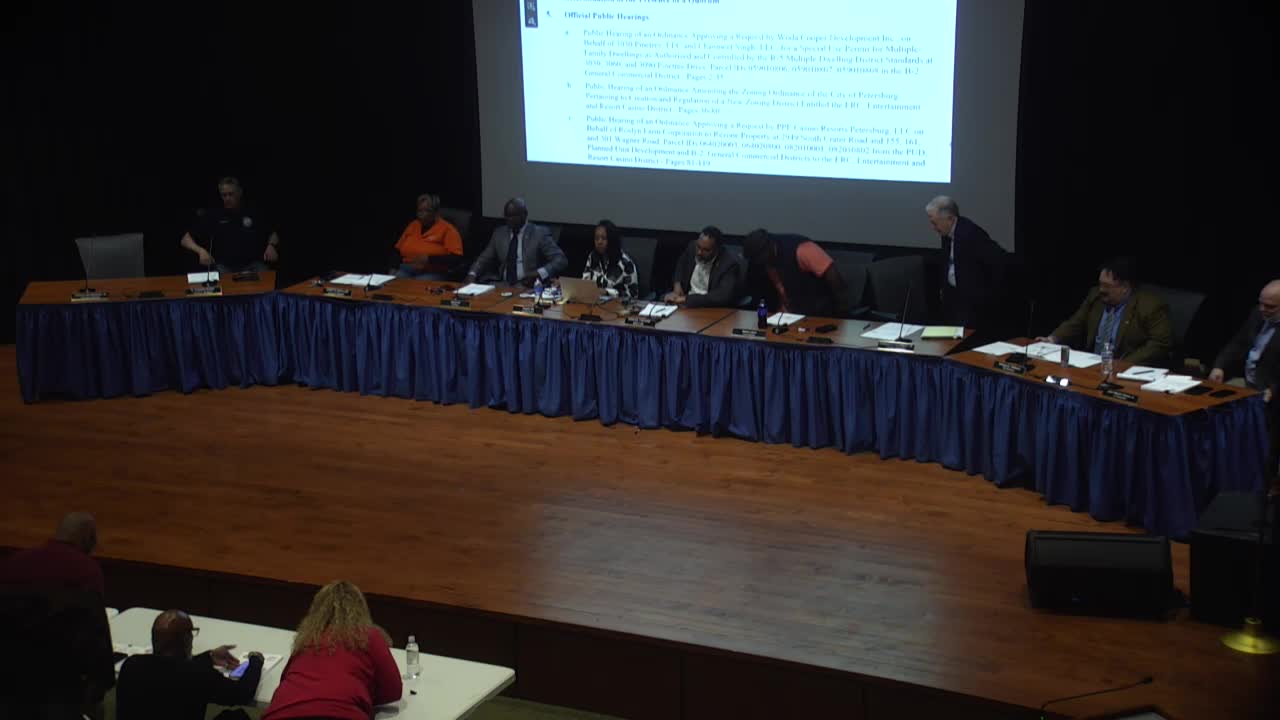
PETERSBURG (Independent City) — The Petersburg City Council on Tuesday backed a Planning Commission decision to deny a special‑use permit for a proposed 50‑unit, three‑story apartment building on Pine Tree Drive, voting 5–1 to support the commission’s denial.
The proposal, filed by Woda Cooper Companies on behalf of 3030 Pine Tree LLC and Chanmeet Singh LLC, would have rezoned three parcels on the west side of Pine Tree Drive (parcel IDs cited in the application) from B‑2 General Commercial to allow multifamily development under R‑5 multiple dwelling standards. City planning staff described the site as roughly three acres, largely wooded, immediately across from the developer’s existing Liberty Point Phase 1 apartments and presented a concept plan showing about 2.3 acres to be developed with the building, parking, a playground, picnic area and landscaping.
Planning Director Naomi Sadmock summarized staff’s recommendation and proposed conditions during the public hearing, including: development according to the submitted site plan and elevations; frontage improvements on Pine Tree Drive (street trees, furniture, sidewalk and pedestrian‑scale lighting); on‑call property management and security surveillance; submittal of final materials at building permit stage; universal design elements with three ADA accessible units; and retention of some wooded area unless further development were approved. Greg Musstrick of Woda Cooper Companies told the council the firm operates affordable housing across 18 states, owns the properties it develops, and planned on‑site property management and service technicians for the new development.
Supporters and skeptics both addressed the council at the public hearing. Residents asked about playground size and broadband availability; Musstrick said the project would include high‑speed internet and a playground similar to Liberty Point Phase 1. Council members and commissioners questioned income targeting, voucher participation and tenant screening. Musstrick said the proposed tenant income ranges for a four‑person household would be about $33,000 to $88,000 and that the project is seeking Section 811 vouchers (for people with disabilities) rather than broad project‑based Section 8 vouchers. He also said the development is intended to use federal low‑income housing tax credits and that staff expected a competitive application.
Planning Commission discussion and a public comment exchange produced concerns about whether Petersburg already had a disproportionate share of subsidized and “light‑tech” affordable complexes. After discussion, Commissioner James Norman moved to deny the special‑use permit; the motion passed in the Planning Commission by roll call (present commissioners recorded as voting Aye included Christian Katzenbach, Tony McDaniel, Thomas Hairston, Alvin Cannon, James Norman, Diane Harley and Fenton Bland; Commissioner Duquan Reinhart was noted as not present during the roll call).
When the matter returned to city council, Vice Mayor Hill moved, and Council member Myers seconded, a motion to support the Planning Commission’s denial. During council discussion, Vice Mayor Hill said the city is “already saturated with light‑tech and subsidized income housing,” and argued vacancies in existing subsidized properties supported denying the new project. Council member Jones voted No; Council members Cuthbert, Myers, Smith Lee, Vice Mayor Hill and Mayor Perham voted Aye. The council’s roll call recorded five Aye votes and one No, and the motion carried.
Details the city discussed but did not adopt as conditions include the developer’s request to modify recommended Pine Tree frontage improvements (a question about whether sidewalks on the opposite side of the street could be added), playground specifications and the number and type of ADA units. Staff clarified that sidewalk construction along the frontage is required by code for any new development on the site, regardless of the special‑use permit outcome.
The record shows the developer planned the building to meet Energy Star standards and to pursue a 15‑year compliance period tied to tax‑credit financing (with possible reapplication for credits later), but planning staff and multiple council members urged caution and asked the developer to confirm funding availability during the tax‑credit application process.
What’s next: The Planning Commission’s denial and council’s vote to support that denial mean the special‑use permit will not proceed as proposed. The developer may choose to revise the proposal and reapply, appeal the denial where allowed by local code, or pursue other options; no follow‑up schedule was set during the meeting.