Get Full Government Meeting Transcripts, Videos, & Alerts Forever!
Get email alerts on the Annexation Disannexation topic
No spam. Unsubscribe anytime.
Midlothian council denies petition to deannex 2.19 acres after residents cite higher taxes
Summary
A request to deannex 2.19 acres from the city was denied 4-1 after residents said city services and taxes motivated their petition and staff said the city is meeting obligations in the annexation service plan.
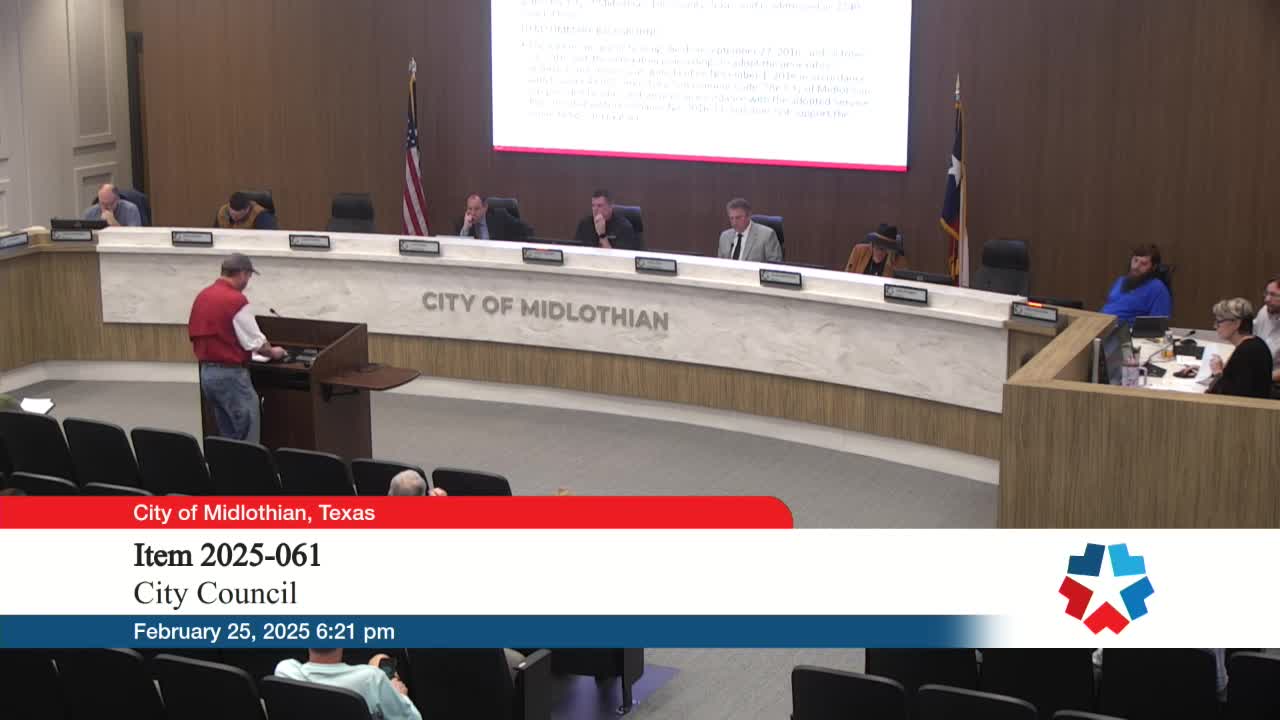
Midlothian council voted 4-1 on Feb. 25 to deny a petition to deannex 2.19 acres addressed in the K.L. Lowenstein survey (petitioners sought removal from city limits).
The vote followed public comment from property owners who said rising property taxes and an unchanged rural character drove their request, and staff testimony that the city is providing services required by the annexation service plan.
The petitioners argued the annexation left them paying city property taxes without the services they expected. Johnny Bishop, who identified himself as living at 2140 Honored Road, said his property taxes “have quadrupled” since annexation and that he and his family chose the property in part for its country feel and lack of city taxes. “We’ve lived there for nearly 20 years,” Bishop said during the public comment period.
City staff told the council the city has provided emergency services, solid waste collection, road maintenance, parks and recreation access, library service, zoning and code enforcement and general municipal administration in accordance with the service plan adopted with the annexation ordinance. Staff also noted that where an exclusive water provider holds a Certificate of Convenience and Necessity, the city is not required to provide service directly; in this area Sardis Loane holds the CCN for water and the properties use septic systems.
City legal staff explained that a statutory path for deannexation exists under the Texas Local Government Code when a city fails to provide services set out in the annexation service plan, but staff asserted the city is meeting the service-plan obligations. Council discussion focused on the legal standard for statutory deannexation and the potential precedent a voluntary deannexation could set for other annexed properties.
A motion to approve the deannexation request failed for lack of a second. Councilman Weaver later moved to deny the request; the motion was seconded by Councilman Sheffield and passed 4-1. The council did not adopt a voluntary deannexation and advised petitioners that, under state law, property owners retain the right to seek relief through the courts if they believe the city has not met service-plan obligations.
Council members who spoke during the debate reiterated concern about creating a “slippery slope” that could invite additional deannexation petitions, while others expressed empathy for the residents’ situation but said the statutory standard for court-ordered deannexation did not appear to be met.
The council’s action leaves the property in city limits; staff will continue to note that residents who believe the city failed to meet service-plan obligations may pursue legal remedies under the Texas Local Government Code.