Get Full Government Meeting Transcripts, Videos, & Alerts Forever!
Get email alerts on the Hotel Occupancy Tax topic
No spam. Unsubscribe anytime.
Council weighs new hotel‑tax policy and two Bee Cave Arts Foundation funding requests
Summary
Council considered a new hotel occupancy tax fund policy and two funding requests from the Bee Cave Arts Foundation but took no final award action; staff was directed to return with a refined policy and a grouped application process.
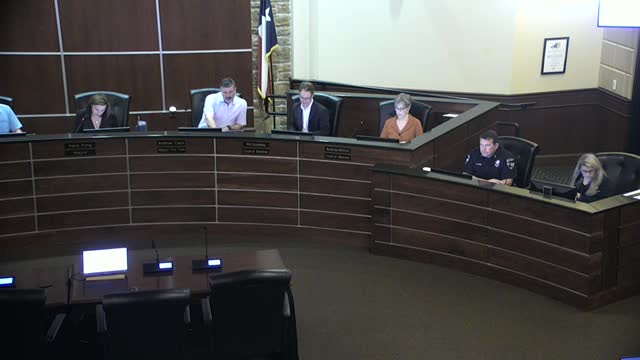
Council and staff spent extensive time on Feb. 26 discussing a draft hotel occupancy tax (HOT) fund policy and two HOT fund applications from the Bee Cave Arts Foundation. The council did not make final awards; instead staff was directed to revise policy language and return with a consolidated process for considering applications.
Staff presentation: Rebecca, assistant to the city manager, described the proposed HOT policy as an effort to reduce applicant confusion and improve administration. Key changes in the draft included fixed application deadlines (application due at least 60 days before an event or expenditure, and a post‑funding report due 60 days after spending), an updated application form and publicity fact sheet, clearer examples of statutorily authorized categories (including the municipal requirement that a portion of HOT receipts be used for advertising), and guidance on permissible uses such as the 15% maximum for promotion of the arts and for historic preservation.
Council debate and policy direction: Councilmembers raised potential unintended incentives from a pure rolling 60‑day rule — for example, applicants might submit requests far in advance or in a rush to secure limited funds. Several councilmembers suggested a fiscal‑year approach with a single annual call for projects (for example, applications due in mid-September for review in October), with an optional secondary round in April if funds remain. Staff reported benchmarking: one city requires a single annual application window and coordinates requests during the budget process; a second-year strategic planning approach for HOT allocations also was recommended.
Staff and council discussed flexibility for first-year transition provisions, whether to allocate a portion of the annual set‑aside (for example, retaining 10–25% for later small requests), and administrative details such as whether to pre‑fund events or reimburse on completion. Rebecca said staff recommends case-by-case determination of advance versus reimbursement payments, with stronger recipients receiving prefunding where risk is low.
Arts applications: The Bee Cave Arts Foundation requested HOT funding for two items: a Light & Music festival (a nighttime “BuzzFest” event with large light installations and a youth music competition) and funding for rotating public sculpture and maintenance of the Bee Cave Sculpture Park.
Debbie Childress, president of the Bee Cave Arts Foundation, presented both proposals and described planned activities, audiences and a draft budget. Council questions focused on hotel‑room impact, event timing, cash flow and the fact that a single award could consume most of Bee Cave’s allowable 15% arts allocation for the year. Staff noted the draft HOT fund balance is limited and that the approximately $70,000 requested for the festival would equal roughly 85% of the 15% arts allocation for the fiscal year (the figure was presented as an estimate by staff).
Council feedback to applicants included: consider scaled budgets or added sponsorships; demonstrate multi‑day hotel impact when possible; and be prepared for either partial awards or negotiation. Council directed staff to group known HOT applicants and consider them together so the council can allocate funds more equitably; staff offered to convene an October application cycle and an April second round if funds remain.
No final grant awards were approved at the Feb. 26 meeting. Council asked staff to revise the policy with language that would (a) establish an annual call for projects timed to the budget process, (b) allow a limited second round if funds remain, and (c) include administrative deadlines for staff processing of applications. The council also asked staff to return with a three‑year funding strategy for HOT allocations.
Why it matters: The draft policy will determine how Bee Cave manages HOT dollars going forward and affect arts groups, event planners and potential tourism outcomes. The council signaled preference for a more strategic, transparent annual allocation process that reduces “first‑come, first‑served” incentives and preserves funding for multiple applicants across the fiscal year.