Get Full Government Meeting Transcripts, Videos, & Alerts Forever!
Get email alerts on the Downtown Transportation topic
No spam. Unsubscribe anytime.
Planning Commission delays action on Austin Core Transportation Plan for further review; staff to brief Urban Transportation Commission
Summary
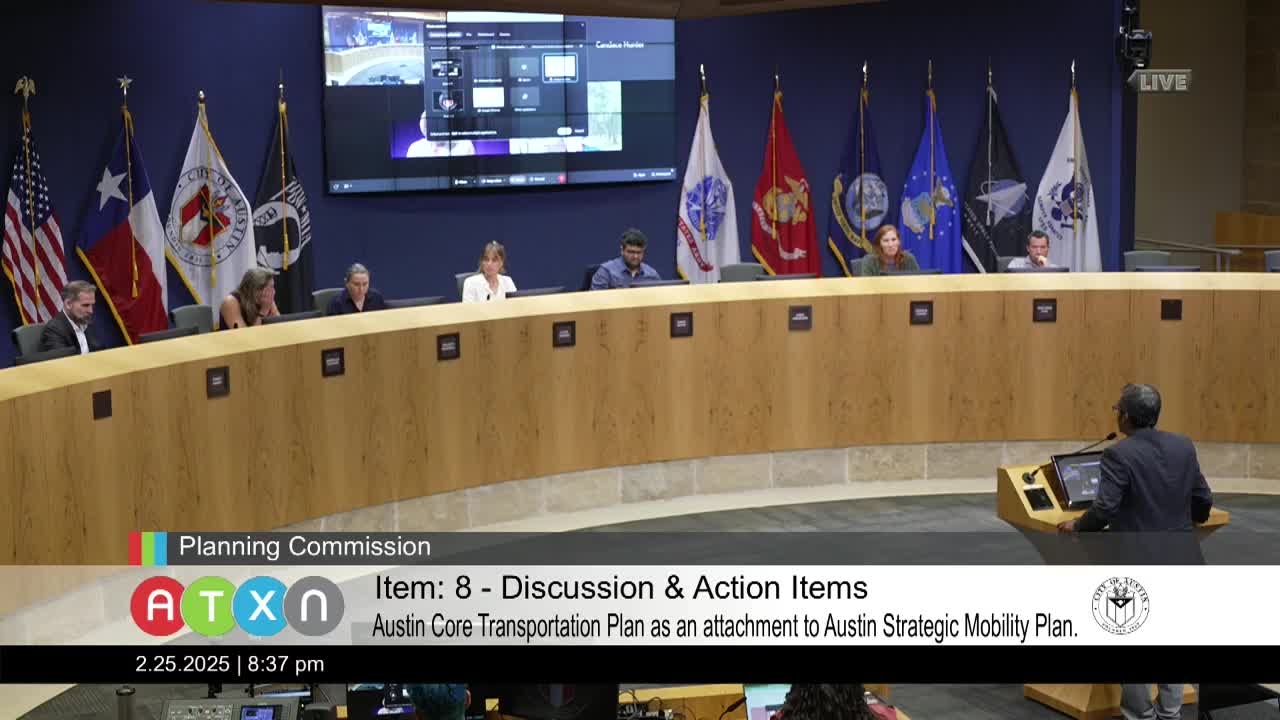
Planning staff presented the Austin Core Transportation Plan—a downtown mobility plan that recommends prioritized street cross sections, transit priority lanes and protected bicycle facilities—then the commission voted to postpone formal action to its March 11 meeting so the Urban Transportation Commission can review the package first.
Staff from Austin Transportation and Public Works presented the Austin Core Transportation Plan (ACPlan) to the Planning Commission on March 6. The plan is a small‑area mobility strategy for downtown intended to be adopted as an addendum to the Austin Strategic Mobility Plan. It lays out street‑by‑street priorities, conceptual cross sections and a staged implementation approach to accommodate major projects—including I‑35 reconstruction and Project Connect—while increasing pedestrian, bicycle and transit priority in the core.
“The intent of the plan is really to take this plan to city council and get this adopted as an attachment to our Austin Strategic Mobility Plan,” said Upal Baruah, assistant director, Austin Transportation and Public Works. The plan identifies high‑priority east‑west corridors (Fifth, Sixth, Seventh and Eighth streets) for multimodal upgrades, recommends transit priority lanes on “heavy lifter” streets, and calls for protected bicycle facilities and widened sidewalks in select segments.
Staff emphasized the ACPlan provides conceptual cross sections and is not a final engineering design: detailed design and engineering will follow during project development, when staff will work parcel‑by‑parcel with property owners and utilities to resolve loading, parking, valet and delivery needs and to balance on‑street uses. “These concepts are intended to be the feeding into that as our starting baseline,” Michelle Marks, transportation officer, said.
Commissioners asked technical questions about two‑way conversions, the relationship between the ACPlan and Project Connect alignments, how the plan treats congestion and parking, and the treatment of specific districts such as Rainey and Sixth Street. Speakers representing downtown property interests asked staff to ensure practical operational support—such as valet and loading—during the project development phase so businesses can operate during and after changes.
Action taken: The commission voted to postpone any recommendation on the ACPlan to the March 11 meeting so the Urban Transportation Commission (UTC) can review the package and provide input before the planning commission acts. Staff said the plan will proceed through additional briefings, stakeholder coordination and preliminary engineering once policy direction is set.
Why it matters: The plan would guide near‑term and longer‑term right‑of‑way decisions in downtown during a period of intense public works and private development. It will shape how the city allocates limited curb and roadway space for pedestrians, bicycles, transit and vehicles as the I‑35 rebuild, Project Connect and major downtown redevelopment projects proceed.
The presentation and commission discussion are summarized from the March 6 Planning Commission transcript; quotes and paraphrases are attributed to speakers who appeared in the record.