Get Full Government Meeting Transcripts, Videos, & Alerts Forever!
Get email alerts on the Wildfire Wui Code topic
No spam. Unsubscribe anytime.
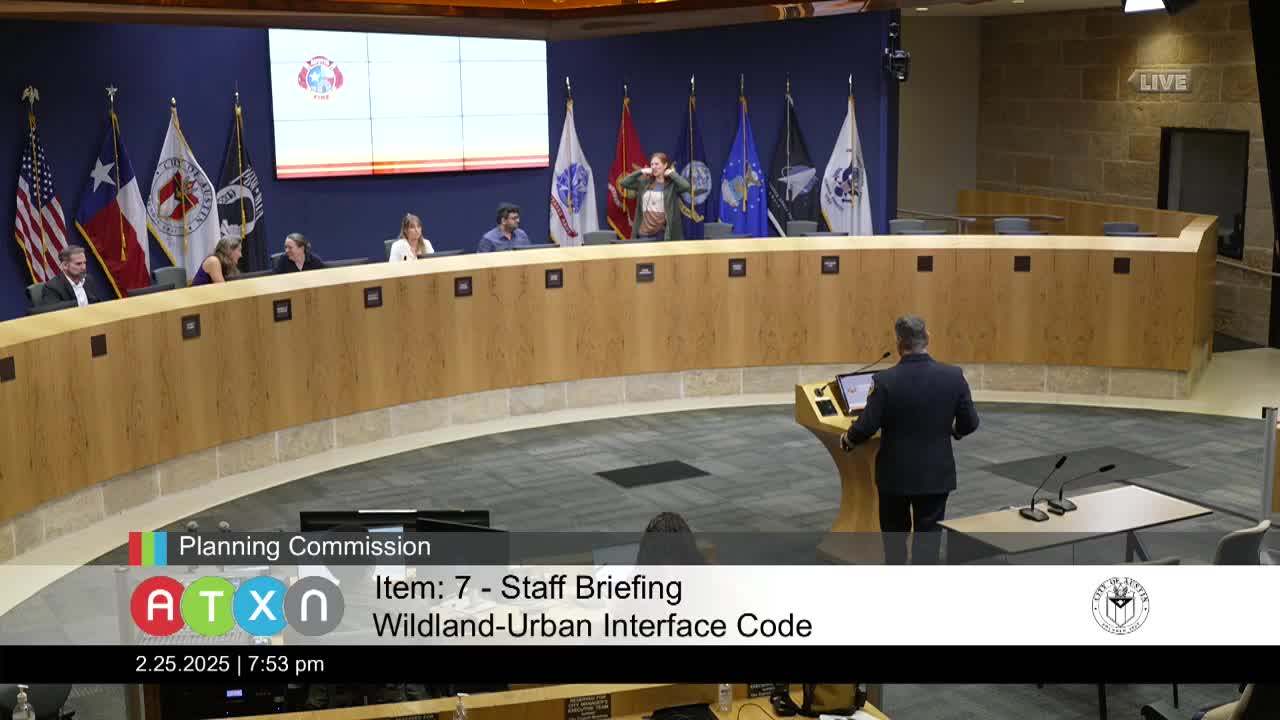
Fire marshal briefs Planning Commission on 2024 Wildland‑Urban Interface code: wider zone C increases reach of requirements
Summary
Austin Fire Department and code staff briefed the Planning Commission on the 2024 Wildland‑Urban Interface (WUI) code update, which formalizes proximity zones and hardening requirements, expands Zone C coverage and clarifies implementation. The item was a briefing only; no action was taken.
City of Austin fire and code officials briefed the Planning Commission on proposed updates to the City’s Wildland‑Urban Interface (WUI) code, aligning local amendments with the 2024 International WUI Code and clarifying local implementation and mapping.
Stephen Truesdale, Austin Fire Department marshal, told commissioners that the 2024 WUI code replaces the 2015 framework adopted locally in 2018 and emphasizes limiting local amendments in favor of the base code and the city’s Fire Protection Criteria Manual. “One of the directives that we were given was to minimize a number of local amendments and emphasize the base code whenever possible,” Truesdale said.
Key changes and intent: The update renames proximity classes as Zone A, B and C; clarifies structure hardening standards for roofs, eaves, soffits and decking; prohibits wood or green roof coverings in the higher‑risk classes; and refines the treatment of accessory structures and decking. The code would require a noncombustible ember‑ignition zone immediately around structures, with research indicating the first five feet have the greatest influence on structure survivability.
Mapping and scope: Mapping revisions drove a major expansion in the geographic reach of the lowest‑intensity category, Zone C. Truesdale said improved mapping (including an effort to count contiguous wildland acreages) made the Zone C footprint much larger than under prior versions; the staff briefing noted that the proportion of parcels in the proximity classes rose substantially under the new methodology, with Zone C coverage increasing markedly. Staff said the mapping methodology has been shared nationally and has undergone review.
Implementation and practical effects: The briefing stressed the code is not retroactive; it applies to new construction and substantial remodels. Staff described engineering and design trade‑offs—such as retaining existing driveway and loading access versus requiring new fire lanes for groups of buildings farther from a fire access road—and noted mitigation options including fire sprinklers and other structure‑hardening measures. The update also contains specific provisions for raised decks, under‑floor enclosures and glazed openings.
Insurance and mitigation context: Fire staff said they have seen growing insurance challenges for some homeowners in higher wildfire‑risk areas and noted that compliance with the WUI code could help residents maintain insurer coverage. Members of the commission asked about state-level support, interagency mutual aid and how WUI work is coordinated with parks and other land owners for mitigation and prescribed burns; staff said they coordinate regionally and with utility providers and parks on mitigation and detection tools.
Process: The WUI update was delivered as a briefing item; the Fire Code Board of Appeals had previously reviewed the changes and recommended adoption. Staff said the package was scheduled to be heard by City Council on a subsequent code hearing date. No commission action was required at the briefing.
The article is based on the Planning Commission transcript and staff presentation; exact quotes and technical descriptions are attributed to speakers listed in the hearing record.