Legislative Analyst describes LAO’s role: budget reviews, midyear notifications and ballot fiscal estimates
Loading...
Summary
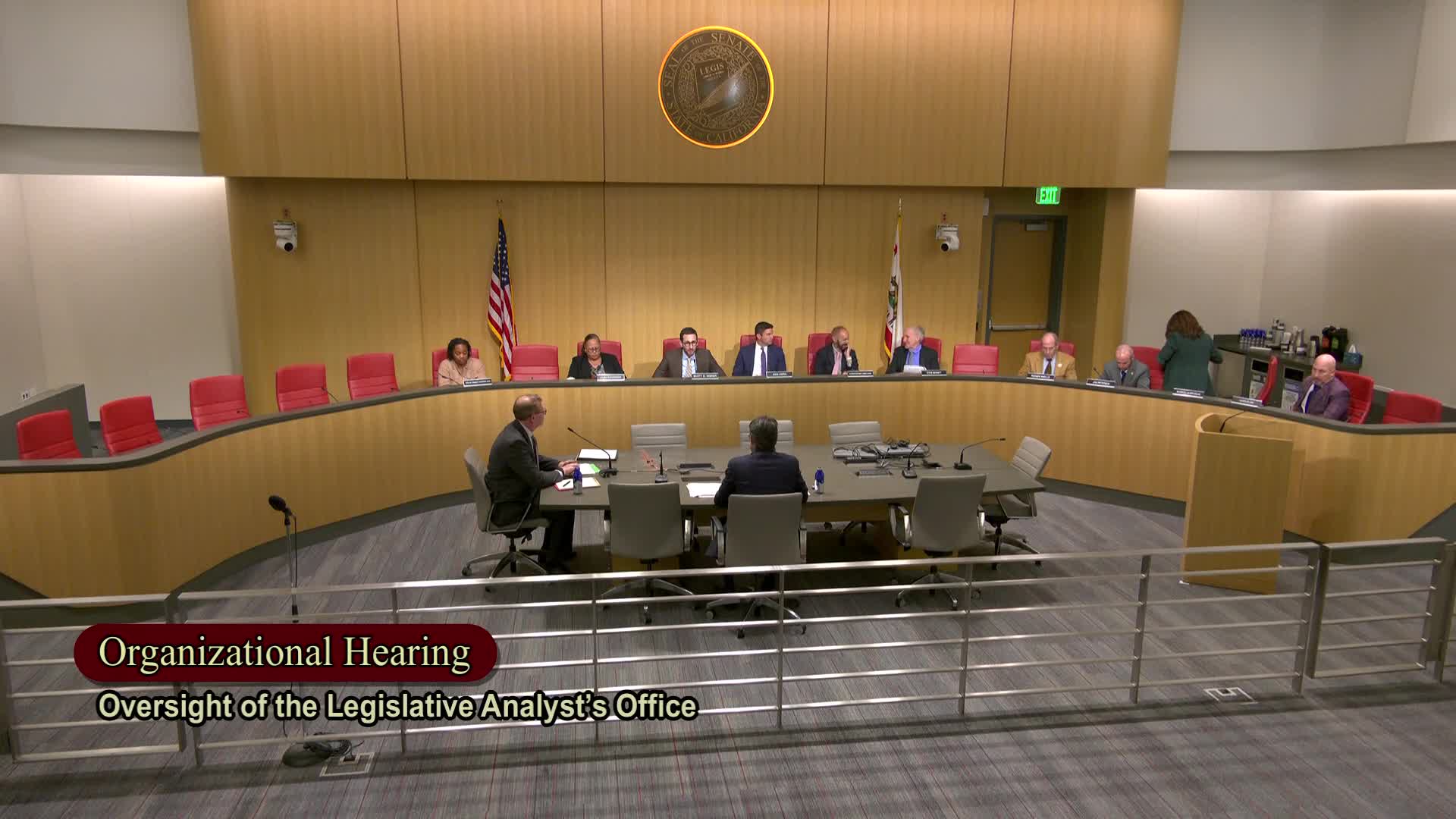
Gabe Pedic, the Legislative Analyst, briefed the Joint Legislative Budget Committee on the Legislative Analyst's Office's history, responsibilities, staffing and role reviewing administration budget notifications and ballot fiscal estimates.
Gabe Pedic, the Legislative Analyst, told the Joint Legislative Budget Committee that the Legislative Analyst's Office (LAO) was established by joint legislative rule in 1941 and is funded from the legislature's budget. Pedic said the office provides independent fiscal analysis to the legislature and noted several core responsibilities: revenue and expenditure estimates, rerunning state funding formulas (including Proposition 98 and Proposition 2), assessing the governor's budget proposals, reviewing midyear administration budget notification letters, and producing impartial fiscal estimates for ballot measures under the Political Reform Act of 1974.
"Our mission is ... to ascertain facts and make recommendations pertaining to the state budget, revenues and expenditures of the state, and also the functions and organizations of state government, its departments, agencies and subdivisions," Pedic said, describing the LAO's fiscal and analytic mandate. He emphasized that the LAO is funded by the legislature and operates with an independence that allows it to double-check administration calculations and provide alternatives and options during budget review.
Pedic outlined the LAO's role on administration budget notifications: the state typically receives these midyear requests when unanticipated federal funds arrive or other events require budget adjustments. "These represent a delegation of legislative authority," he said, adding that in a typical year the office receives roughly 100 to 200 notification letters. He said the LAO writes detailed analyses for a smaller subset of requests when it identifies issues—such as inconsistency with prior legislative action—or when the administration requests a shortened review period (a waiver of the usual 20- or 30-day review window).
Hans Hayman, principal consultant with the JLBC, described how notifications are distributed: "All of the notifications are sent out to the JLBC membership," he said, and the LAO coordinates with budget consultants in both houses when questions arise. Pedic noted that the LAO also provides confidential assistance at members' requests, produces fiscal assessments of memoranda of understanding with state employee unions, and prepares fiscal analyses for ballot measures at both petition and measure stages.
Pedic summarized the office's staffing and product output: the LAO has about 40 analysts and 10 support staff organized into eight analytical units that correspond to major budget areas. He said the LAO publishes its analyses on lao.ca.gov and that its public-facing products and conference appearances are intended to support the legislature's oversight role.
Committee members asked several questions. Senator Nilo praised the LAO's work and impartiality. Senator Cabaldon asked about one data point in a chart of LAO products and whether pandemic effects explained a change in office output; Pedic said he would look into the specific number and suggested the pandemic could be a factor. Hans Hayman answered a procedural question about distribution of notifications and explained the LAO shares draft letters with budget consultants and relevant subcommittee staff before finalizing responses.
No formal committee action was taken on the LAO briefing; the session proceeded to other business after members' questions.