Get Full Government Meeting Transcripts, Videos, & Alerts Forever!
Get email alerts on the Commercial Diving Safety topic
No spam. Unsubscribe anytime.
Senate committee advances bill tightening scuba-diving safety for lake weed removal after two deaths
Summary
The Senate Labor Committee voted to advance Senate File 1346, the “Brady Ani and Joseph Anderson Safety Act,” imposing new training, equipment and permitting requirements for commercial aquatic plant management using scuba gear after two fatal workplace incidents.
The Minnesota Senate Labor Committee on Jan. 25 advanced Senate File 1346, the Brady Ani and Joseph Anderson Safety Act, which would impose new training, equipment and permitting requirements on companies that use scuba gear in aquatic plant management.
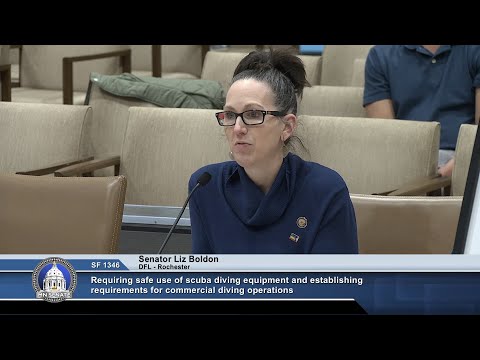
Senator Sandra Bolden, the bill's sponsor, told the committee the measure responds to two recent workplace deaths involving commercial lake-weed removal. "This bill would create new worker safety requirements for aquatic plant management with a focus on the work when scuba gear is in use," Senator Bolden said as she opened the hearing.
The bill would add new requirements in two areas: the Department of Natural Resources' (DNR) aquatic plant-management permitting process, and Minnesota's application of occupational-safety rules for commercial diving.
Under the DNR-related provisions, applicants for commercial mechanical control permits would have to disclose whether scuba equipment will be used. If so, the permit application must include a third-party on-site hazard survey performed within the prior year by a qualified safety professional (examples listed in the bill include a Department of Labor and Industry representative, a workers' compensation insurance underwriter, or an outside consultant). The measure would also bar the DNR commissioner from issuing or renewing a permit for applicants who have one or more willful OSHA scuba-related violations in the previous two years and would prevent a successor person from obtaining a permit where the prior operator had such violations. The committee was told those permit-related provisions would apply to permits or violations on or after Oct. 1, 2025.
On workplace rules, the bill would create a new section of Minnesota OSHA law that applies to employer-operated commercial diving using scuba apparatus. It would require that individuals using scuba gear hold at least an open-water scuba certification from a nationally recognized provider (or a higher certification). Employers would also have to require a buoyancy control device (BCD) and an illuminated dive beacon when scuba equipment is used. The Department of Labor and Industry (DLI) would develop an informational sheet for employers and post it on its website; DLI would also supply that sheet to the DNR for use in the permitting process. The effective date for the OSHA-style provision in section 3 is May 1, 2025, as reflected in the amended bill.
Committee amendments expanded equipment and training requirements. Senator Paul Liske (mover of several amendments) offered an amendment (A4) that required a minimum equipment list aligned with standard open-water diving requirements: fins, mask, snorkel, compressed gas cylinder with valve, primary regulator and alternate air source, a breathing-gas monitor, depth monitor, quick-release weight system, appropriate exposure protection, an audible emergency surface signaling device and a dive computer. That amendment was adopted by the committee.
Another adopted change (from a divided portion of the A5 amendment) requires that all members of the dive team hold current CPR and first-aid certification. A separate amendment (A6) adopted by the committee requires that at least one individual on-site hold a rescue-diver certificate issued by a nationally recognized accredited program.
Family members of two young men who died while doing lake weed removal — Brady Ani and Joseph (Joe) Anderson — testified in support of the bill. Dina Ani, the mother of Brady Ani, told the committee: "I am Brady's mother" and described the family's assumption that employers would provide proper training prior to allowing employees to use scuba equipment. Brady's father, William Ani, said the deaths were preventable and urged swift legislative action: "Only when you mandate employers to comply with safety standards will the job become safe for employees."
David and Laurie Anderson, the parents of Joseph Anderson, described circumstances similar to Brady's death and said OSHA found five willful violations in Joe's case and fined the employer $730,000. David Anderson urged the committee to act quickly, noting companies implicated in the incidents continued to advertise for spring work.
DLI Commissioner Nicole Blissenbach told the committee that federal OSHA's commercial diving regulations already apply and were the basis for Minnesota OSHA's prior enforcement; she cited the federal regulatory language that requires dive-team members to be trained in CPR and first aid (transcript reference to 29 CFR). The commissioner also explained that Minnesota generally adopts federal OSHA wording and that changes at the federal level would typically be adopted in Minnesota by rulemaking unless the Legislature acted differently.
Committee action and next steps: The committee adopted sponsor-author amendments to clean up technical language and to name the bill the "Brady Ani and Joseph Anderson Safety Act." After considering testimony and adopting the equipment and training amendments described above, the committee voted to recommend passage as amended and re-referred Senate File 1346 to the Environment, Climate and Legacy Committee. The motion passed on a voice vote; no roll-call tally was recorded in the hearing transcript.
The bill as amended places new obligations on both permit applicants to the DNR and employers who employ divers for hire. It creates state-level statutory text that references and elaborates on federal commercial-diving requirements, adds permit screening tied to prior willful OSHA violations, and creates criminal/penalty references via citation to the state general penalty provisions contained in Chapter 182 (as cited during the hearing). The committee discussion made clear DLI and DNR staff will produce the information sheet for employers and that the bill's detailed equipment and certification language may be further refined as the bill proceeds through additional committees.
Votes at a glance: The committee adopted the author's A2 and A3 amendments (A3 names the bill), the A4 equipment list amendment, the divided portion of A5 requiring CPR/first aid certification for dive team members, and the A6 requirement that at least one on-site person hold a rescue-diver certificate. The final motion to recommend passage of Senate File 1346 as amended and re-refer it to Environment, Climate and Legacy passed by voice vote.
Background and context: Senators and witnesses repeatedly compared scuba diving in murky lake conditions to other immediately dangerous-to-life-and-health (IDLH) occupations such as firefighting, noting the potential for equipment malfunction, entanglement in weeds, and rapid loss of orientation in low-visibility water. Testifiers and witnesses urged prompt action prior to the spring field season to reduce the risk of further fatalities.
A portion of the committee's concerns centered on whether the state should restate federal OSHA requirements in statute or rely on DLI rule adoption and whether statutory language should be more prescriptive. DLI noted Minnesota adopts federal OSHA wording and that, absent legislative action, changing federal rules would require DLI rulemaking to alter Minnesota's requirements.
The committee hearing record indicates continued engagement and further steps are expected as the bill moves to Environment, Climate and Legacy and, if needed, finance committees.