Get Full Government Meeting Transcripts, Videos, & Alerts Forever!
Get email alerts on the Hoa Cic Reform topic
No spam. Unsubscribe anytime.
Legislative working group recommends 41 reforms for Minnesota HOAs; bill introduced, advocates urge ombudsman and dispute resolution
Summary
A bipartisan legislative working group on common-interest communities and homeowners associations presented 41 recommended reforms to the Senate Housing and Homelessness Prevention Committee, proposing new governance standards, limits on fees and fines, foreclosure protections, and expanded dispute-resolution and registration requirements.
A bipartisan legislative working group on common-interest communities and homeowners associations (HOAs) presented 41 recommended reforms to the Senate Housing and Homelessness Prevention Committee, proposing new governance standards, limits on fees and fines, foreclosure protections, and expanded dispute-resolution and registration requirements.
Andrew George, nonpartisan staff with the Legislative Coordinating Commission, told the committee the group met through the interim and gathered stakeholder testimony, public listening sessions and presentations from legal aid and national organizations. The working group identified eight issue areas: governance; financial interests; dispute resolution; registration and education; assessments (fees and special assessments); foreclosures; municipal interactions; and civil rights and disabilities.
The scale of the sector the working group examined: George cited roughly 1.5 million Minnesotans living in common-interest communities, nearly 8,000 CICs statewide and about 3,800 in the Twin Cities metro. He also said "82% of new homes sold in 2023 were part of the CIC."
Legal Aid attorney Ronald Elwood, a working-group participant, told the committee his organization represents homeowners who have faced foreclosure or large fines. "There really is a pressing need for reform in this area," Elwood said, summarizing themes that included excessive fines for minor rule violations, foreclosures for modest delinquencies, conflicts of interest and uneven transparency.
The working group's 41 recommendations, presented at high level, include: - Governance: require open forums in meetings; set clear, reasonable standards for board and management decisions; revoke unenforced covenants unless renewed; limit certain private-property restrictions; and remove 515B governance over housing cooperatives where 308C applies. - Financial interests: require annual financial accounting, establish conflict-of-interest standards for boards, property managers and vendors, require multiple bids for vendors, and study HOA insurance market issues. - Dispute resolution and oversight: require internal dispute-resolution procedures, create templates and education resources, fund or create a housing advocacy center, and recommend establishing an ombudsman to mediate HOA complaints and host public materials. - Registration, education and licensing: require CICs to provide basic information about rights and responsibilities at no charge, consider manager licensing, and create a public database (with protections for board members' personal contact details). - Assessments and fees: set caps and standards for fines and fees, require notice periods (a 30-day notice for non-emergency fee increases and a 60-day notice for special assessments were suggested), and consider expanding homeowner loan programs (HIA loans) to help pay for repairs. - Foreclosure: apply newer foreclosure protections to some older townhomes not currently covered, prohibit HOA foreclosure on liens for fines totaling less than $2,500, insist pre-foreclosure notices explain the who/what/where/when/why and allow postponement of a sale, and bar aesthetic-rule violations from being foreclosable offenses.
Homeowners and advocates provided testimony that echoed those concerns. Becky Cole, a homeowner who testified remotely, said current law can leave homeowners with few remedies: "Current law doesn't require HOAs to be run with sane sound business practices that would never be tolerated in any other business or industry," she said, adding that the law can leave homeowners exposed to large fees, attorney charges and foreclosures while offering little recourse.
Phaedra Howard, an attorney who represents community associations, raised process concerns. "There was no representation on the working group by any homeowners who serve on their board of directors in an association," she said, arguing that volunteer board members' perspectives were underrepresented and calling for more education alongside statutory reforms.
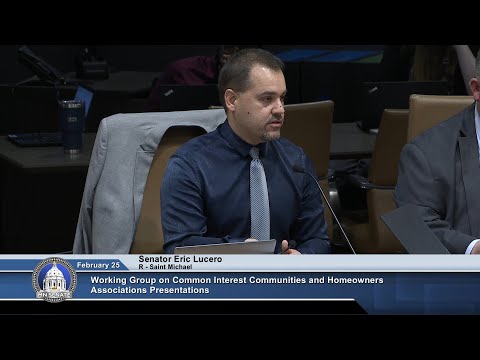
Senator Sarah Lucero and Senator Pa, who served on the working group, said a bill to implement many recommendations has been drafted (transcript: "Center File 1750"). They also noted related measures: an ombudsman/mediation bill carried by Senator Marty and separate proposals to build a registration database and education materials; committee leaders said fiscal and policy details will be refined as bills move through the session.
Provenance (transcript excerpts): "The working group on common interest communities and homeowners associations, met during the interim... The working group was created in the 2024 legislative session to study the prevalence and impact of common interest communities and homeowners associations in Minnesota..." (Andrew George, transcript block starting at 2531.615 seconds).
"There really is a pressing need for reform in this area," (Ronald Elwood, Legal Aid attorney; transcript block ~3630 seconds).
Ending: Sponsors said the bill is the beginning of a legislative process that will be open to amendments and stakeholder feedback. Committee members signaled continued debate on dispute resolution, foreclosure thresholds and registration rules as sponsors refine language and fiscal impacts are assessed.