Get Full Government Meeting Transcripts, Videos, & Alerts Forever!
Get email alerts on the Grants Administration topic
No spam. Unsubscribe anytime.
Minnesota Humanities Center briefs committee on record demand and new legacy grant lines
Summary
The Minnesota Humanities Center told the committee it administered roughly $15.4 million in grants this biennium across multiple new and existing legacy grant lines, reported unprecedented demand and described outreach, review and monitoring procedures for grant awards.
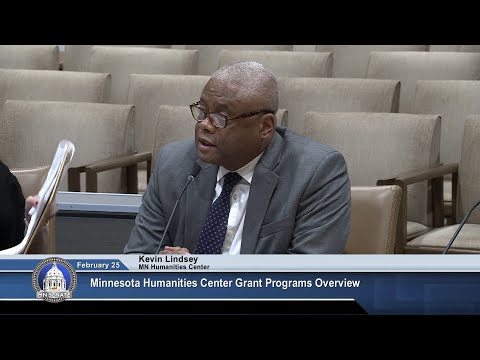
Officials from the Minnesota Humanities Center provided the Senate Committee on Environment, Climate and Legacy with an overview of grants administration across multiple legacy grant lines and described demand, outreach and review processes used during the current biennium.
Kevin Lindsay (director) and Tristy Auger (grants manager) told the committee the center administered approximately $15.4 million in grant awards this biennium across nine grant buckets. Lindsay summarized new and expanded grant lines created by the legislature — cultural heritage grants (about $9 million allocated), festivals, capacity building ($750,000), emergency response grants ($100,000), children’s museums (a competitive pool of about $2.2 million in addition to a direct appropriation), civics, and cultural and ethnic studies — and said demand far exceeded available funds in most categories.
Lindsay and Auger described outreach strategies (targeted media, radio, TV and BIPOC outlets), application assistance for new applicants, streamlined application forms, review panels selected for statutory diversity criteria, initial completeness screens, financial reviews and interim reporting. They said the center provided grantee orientation, best‑practice newsletters, one‑on‑one technical assistance and that final payments required submission of final reports and documentation. Lindsay also noted that the center coordinates its grant administration with the Department of Administration’s OMNIA/OMVG processes and uses external auditors for annual financial reviews of grantees.
Committee members asked about language accessibility for applicants, reporting and monitoring procedures, and the use of emergency response grants; staff said all emergency grant funds were awarded before an October deadline and that demand for similar grant lines would likely be high in future cycles. Lindsay said the center will provide its annual report with more detail and welcomed further questions about implementation.