Get Full Government Meeting Transcripts, Videos, & Alerts Forever!
Get email alerts on the Campaign Finance Fraud topic
No spam. Unsubscribe anytime.
Senate panel advances bill creating civil and criminal penalties for fraudulent 'scam PAC' fundraising
Summary
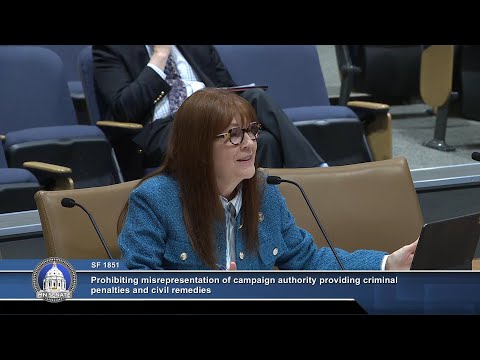
The Senate Elections Committee voted Feb. 25 to send Senate File 1851 to the Judiciary Committee. The bill would make knowingly misrepresenting a campaign or organization to solicit donations a gross misdemeanor and create civil remedies for the attorney general, county attorneys or injured donors.
The Minnesota Senate Elections Committee on Feb. 25 recommended Senate File 1851 to the Judiciary Committee after adopting the bill's author's amendment and rejecting a separate, proposed change by roll call.
Senator Westland, vice chair of the Senate Elections Committee, told members the bill targets “scam PACs” — political-action committees that solicit donations by falsely implying they support a candidate, party or issue and then divert most funds to fundraising expenses or to operators' benefit.
The measure would criminalize misrepresenting a person, campaign or organization with intent to defraud and would allow the attorney general, a county attorney or an injured party to bring civil actions for damages, investigation costs and reasonable attorney fees. The bill makes such conduct a gross misdemeanor and authorizes civil penalties up to $1,000 per violation.
“Scam PACs are political action committees that claim to raise money for political causes … but instead secretly divert almost all of their donors' money back into fundraising or into their own pockets,” Elizabeth Shimek, senior legal counsel for campaign finance at the Campaign Legal Center, said in testimony in support of the bill.
Committee discussion included concrete examples and limits to enforcement. Westland cited enforcement examples in recent years: a 2022 group called Law Enforcement for a Safer America that raised $14,000,000 but, according to the bill sponsor's remarks, spent 87% of donations on fundraising; and two groups that used a presidential audio clip, where one group raised about $1,400,000 and, as described in testimony, reportedly contributed about 3% of funds to the named beneficiary.
Committee counsel and members emphasized the bill focuses on the fraudulent misrepresentation used to solicit funds rather than on every instance of high fundraising overhead. Counsel said whether diverted payments to a related vendor constitute criminal intent will be a fact-specific inquiry: paying a vendor that actually performs the work the PAC claimed to buy may not be fraud, but routing funds to enrich insiders while falsely claiming the proceeds will support a candidate could fall within the proposed crime.
Committee members also debated the scope of remedies. The bill’s civil provisions rely on authority in chapter 8.31, which governs attorney-general actions; sponsors said the measure is intended to create an explicit private right of action in addition to prosecutorial authority. The committee adopted the bill's A1 amendment, which adjusted language about who may sue and the public-benefit standard, but it rejected an oral amendment that would have expanded the text to say organizations could act “for or against” a candidate or issue (roll-call result: 5 ayes, 6 nays).
Senator Porteous moved that Senate File 1851, as amended, be recommended to pass and referred to the Judiciary Committee; the motion passed by voice vote.
The measure's sponsors and the Campaign Legal Center characterized the bill as a targeted tool against deceptive fundraisers that use misleading names, robocalls or other tactics to mislead donors. Supporters said the bill aims to protect older and veteran donors whom they said are often targeted. Opponents and some members cautioned the measure may overlap with existing theft and fraud statutes and recommended further review by Judiciary staff before final drafting.
Votes at a glance: A1 author's amendment — adopted (voice vote). Lucero proposed amendment to insert “or against” — failed (roll call 5–6). Final recommendation: SF 1851 as amended — recommended to pass and referred to Judiciary (voice vote).
The committee record shows the bill will next be considered by the Senate Judiciary Committee; no further changes were adopted in the Elections Committee.