Get Full Government Meeting Transcripts, Videos, & Alerts Forever!
Get email alerts on the Healthcare Workforce topic
No spam. Unsubscribe anytime.
Committee approves amendment to keep funding for Bridges to Healthcare program
Summary
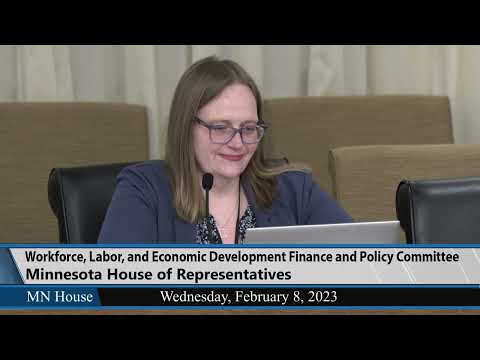
A Minnesota House committee heard testimony on House File 661 and approved an author's amendment to maintain prior workforce-development funding for the Bridges to Healthcare program, then laid the bill over for further consideration.
A Minnesota House committee approved an author's amendment to House File 661 and heard testimony about the Bridges to Healthcare program, a public–private initiative that helps nontraditional students enter health-care careers in southeastern Minnesota.
Representative Rosanna Hicks introduced House File 661 and described the bill’s goal to maintain funding for the program. “This program, known as the Bridges to Healthcare, initially launched in the Rochester area and has expanded throughout Southeastern Minnesota,” Hicks said, noting Rochester is home to the Mayo Clinic and citing the program’s reach to cities including Albert Lea, Austin, Faribault, Owatonna, Red Wing and Winona.
The program’s convening and administrative agency, Workforce Development Incorporated, detailed demand and outcomes. Kyle Mullin, adult services director at Workforce Development Incorporated, said the region currently has “approximately 4,500 open RN vacancies, [and] 2,500 open nursing assistant vacancies,” and described long-term care vacancy rates above 10 percent. Mullin said the program exceeded its original target of supporting 300 students per year and is “already over 300 for this year and projected to hit 420 for this biennium.”
Representative Hicks and Mullin said the program received $750,000 per year from the workforce development fund in the last biennium and that the expansion and operation the committee discussed would require roughly $1,000,000; Mullin said about 25 percent of operating funds come from private sources. Mullin also said “80 percent of our students who graduate are from ethnically diverse backgrounds, and 60 percent go into that long term care industry.”
Student testifiers described personal impacts. One in-person testifier said the program paid for supplies and helped with barriers such as transportation and rent; Rebecca Sullivan said the program covered scrubs, class fees and helped her through “a really tough time in my home life,” enabling stability that supported her training.
Committee members asked about placement and program structure. Rep. Zalesnikar asked whether placement rates matched the enrollment numbers; Mullin replied he did not have exact placement figures in the hearing but estimated “over 95 percent are going to be either continuing their education or entering into employment,” and said he would provide exact numbers on request. Members also asked whether Bridges to Healthcare is a distinct legal entity; Mullin and Hicks indicated Workforce Development Incorporated administers the program and that the funds are used to pay for training, supplies and career counseling provided by community and technical colleges and adult basic education providers.
The committee’s chair moved and the committee adopted an author’s amendment clarifying that funds in the bill would not be used for facility space or infrastructure. The amendment was adopted by voice vote. As amended, the chair announced the committee would carry House File 661 over for further consideration or inclusion in another bill.
The committee did not record a roll-call vote on the amendment or on carrying the bill over; those actions were announced by the chair during the hearing.