Get Full Government Meeting Transcripts, Videos, & Alerts Forever!
Get email alerts on the Zoo Infrastructure topic
No spam. Unsubscribe anytime.
Minnesota Zoo asks Legislature for $17.7 million for new animal hospital, $3.8M in asset preservation
Summary
The Minnesota Zoo told the Senate Committee on Capital Investment it needs $17,675,000 in state bonding for a new animal hospital and more than $3.8 million for asset preservation, citing an outdated 1975 facility, ventilation and safety problems, and a $30 million total project cost supported by $9 million in private fundraising.
The Minnesota Zoo asked the state Senate Committee on Capital Investment on Feb. 25 for $17,675,000 in bonding to build a new animal hospital and for more than $3.8 million in asset preservation for its aging campus.
The request is part of a roughly $30 million project estimated to replace an animal hospital built in 1975; the zoo said it has raised about $9 million in private funds toward the effort. "I'm John Froley, director of the Minnesota Zoo," Froley told the committee as he introduced the zoo's proposal.
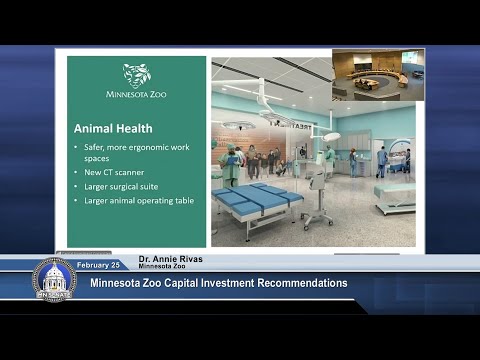
Why it matters: Zoo officials told lawmakers the current hospital lacks modern infrastructure required for veterinary standards and poses risks to both animals and staff. "The current facility lacks the essential infrastructure needed to meet both the USDA and modern veterinary standards," said Anne Rivas, director of animal health at the Minnesota Zoo, describing deteriorating holding areas, an undersized surgical suite and ventilation problems that have contributed to post‑surgical infections.
Officials described several specific operational problems they say the new hospital would address: large-animal operating space (the current surgical area forces some procedures onto folding tables), a CT scanner and diagnostics suite, improved animal holding and quarantine space, mitigation of asbestos and mold, and an indoor ambulance/loading bay to allow treatment vans to remain stocked year-round. Rivas said the lack of an indoor loading dock has forced staff to load anesthetized large animals over an outdoor dock in all seasons, creating human and animal safety risks.
The zoo framed the project as statewide in scope: staff said the new facility would serve the zoo’s roughly 5,000 animals and could act as a teaching hospital and regional resource to support wildlife and livestock veterinary needs across Minnesota. Froley told the committee the zoo is a state agency operating as a public‑private partnership and that only 37 percent of its funding comes from the state; the remainder is earned revenue and private support. He also noted the zoo’s scale — roughly 500 acres and about 1.5 million visitors in the prior year — to underline the public use of the site.
Committee members asked about the development timeline and past funding. Froley said the zoo previously received state design funding and that the $17.675 million figure reflects an inflation adjustment from a $15 million ask in the prior year. The zoo described the asset preservation ask as covering numerous campus repairs on its 50‑year‑old campus; Froley told the panel the zoo provides access programs serving more than 120,000 guests free of charge and educates more than 83,000 students annually.
Next steps: Zoo staff stood for committee questions and said they would return to the Legislature as the project advances through design and permitting. No formal vote or funding action occurred during the hearing.
Ending: The zoo’s request was presented early in the committee hearing and advanced to Q&A; the committee did not take immediate action on the request.