Get Full Government Meeting Transcripts, Videos, & Alerts Forever!
Get email alerts on the Gambling And Enforcement topic
No spam. Unsubscribe anytime.
Committee hears overview of Minnesota gambling regulation, enforcement work and charitable‑gambling finances
Summary
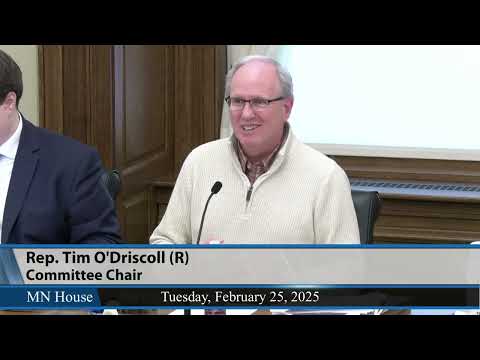
On Feb. 25, 2025, the House Commerce Finance and Policy Committee received an overview of gambling law and enforcement in Minnesota from House Research, the Alcohol and Gambling Enforcement Division (Department of Public Safety), and the Minnesota Gambling Control Board.
On Feb. 25, 2025, the House Commerce Finance and Policy Committee received an overview of gambling law and enforcement in Minnesota from House Research, the Alcohol and Gambling Enforcement Division (Department of Public Safety), and the Minnesota Gambling Control Board.
Alex Hagler of House Research described the lawful forms of gambling in Minnesota: charitable gambling (codified in Minn. Stat. ch. 349), the state lottery (ch. 349A), pari‑mutuel horse racing (statutory provisions and constitutional authorization, chapter cited in testimony), and tribal casinos authorized by compacts with federally recognized tribes. Hagler noted that sports betting remains unlawful in Minnesota despite the 2018 U.S. Supreme Court decision that opened the door for states to authorize sports betting, and that other states have since authorized retail or mobile sports wagering.
Carla Sincotta, director of the Alcohol and Gambling Enforcement Division at the Department of Public Safety, summarized enforcement work and investigative resources. She said the division has 28 staff including 10 sworn officers, and she highlighted Via, a currency‑detection canine that the division deployed to recover funds: "She's gone on 41 deployments since she came to our division in the fall of 2022 and she has recovered over dollars 777,000." Sincotta described cooperative investigations with the Gambling Control Board, the Lottery and the Racing Commission, background checks for key gaming personnel, criminal investigations of illegal gambling and lottery fraud, and tribal slot‑machine accounting system reviews.
Minnesota Gaming Control Board Executive Director Laura Wade outlined the charitable‑gambling sector and post‑2023 legislative changes. Wade said lawful (charitable) gambling in Minnesota—pull‑tabs, bingo (paper and electronic), raffles, paddle wheels and tip boards—generated about $4.9 billion in gross receipts in the most recent year, paid roughly $4.2 billion in prizes, remitted about $170 million in taxes to the state, and made roughly $140 million available for charitable or mission‑related expenditures. She noted the board enforces game fairness, inspects operations across the state, licenses organizations and provides outreach and education.
Legislative changes and enforcement details
- 2023 law changes: Wade summarized the 2023 legislative package that placed restrictions on some electronic pull‑tab features, reduced the number of organizations required to obtain annual CPA audits, cut organization tax liabilities (which reduced aggregated taxes compared with pre‑change levels), and capped distributor fees for electronic pull‑tab games. Wade said preliminary data show a decline in electronic pull‑tab sales in January–February after the restrictions took effect but that statewide sales have fluctuated since November and the sample size is small.
- Enforcement caseload and audits: Sincotta reported that the division completed a combined set of investigations in calendar 2023 including 24 illegal‑gambling investigations, 16 lottery investigations, 5 Racing Commission matters and 44 matters with the Gambling Control Board; the division also performs tribal audits and reported having completed more than 18,000 slot‑machine accounting system reviews.
- Out‑of‑state/mobile sports betting and illegal operations: Committee members asked whether state investigators pursue unlawful online sports‑betting operators. Sincotta said the division opens criminal investigations on complaints about illegal online operators but that enforcement can be difficult when funds flow out of state or overseas.
Member questions and data follow‑up
- Lottery receipts and charitable distribution: Representative Dotseth asked about state lottery revenue; Hagler said the committee would be supplied that figure later. Wade noted that about 18 percent of net receipts (gross receipts less prizes) were used for mission‑related expenditures by charities in the most recent report.
- Online raffles and social media: Sincotta said online raffles fall under the Gambling Control Board when they are run lawfully; otherwise, unlicensed activity is subject to joint investigation by the Gambling Control Board and the Alcohol and Gambling Enforcement Division.
- Licensing churn: Wade told the committee the Gambling Control Board issues roughly 30 new charitable‑gaming licenses a year and loses about 30 annually, reflecting organizations starting and ceasing operations.
No committee policy votes on gambling were recorded during the session; presenters offered to provide requested follow‑up data to members and to answer additional technical questions as the committee considers gambling‑related bills later in the session.