Get Full Government Meeting Transcripts, Videos, & Alerts Forever!
Get email alerts on the Liquor Regulation topic
No spam. Unsubscribe anytime.
Committee hears overview of Minnesota liquor regulatory framework, small-producer exceptions and local licensing
Summary
On Feb. 25, 2025, the Minnesota House Commerce Finance and Policy Committee heard House Research and state enforcement staff review the state's modified three-tier liquor regulatory system, local licensing authority, exceptions for small producers and recent statutory changes including Sunday sales and allowances for small brewers.
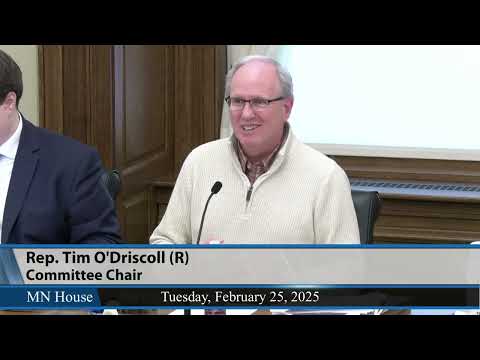
On Feb. 25, 2025, the House Commerce Finance and Policy Committee received a primer on Minnesota's liquor regulatory system from House Research staff and state enforcement officials. Chair, House Commerce Finance and Policy Committee, opened the session and the committee formally adopted the minutes from its Feb. 20 meeting after Representative Smith moved to accept them: "I actually did. So I moved to accept those minutes." The motion carried on a voice vote.
House Research presenter Chris Clayman told the committee Minnesota follows a modified three-tier system that separates manufacturers, wholesalers and retailers, with statutory exceptions for smaller producers such as microbreweries and brewpubs. Clayman said, "On‑sale retailers sell alcohol for consumption on the premises ... Whereas off‑sale retailers sell alcoholic beverages to individuals for consumption off the premises." He described the three‑tier approach as intended to reduce the vertical integration and market concentration that critics associated with the pre‑Prohibition era and to increase transparency and local control.
Why it matters: lawmakers heard that the structure affects where products may be sold, how small producers operate, and the ability of local governments to restrict or permit liquor sales in their jurisdictions. Members repeatedly pressed staff on the practical effects of the rules—for instance, whether wholesalers may move product between retail locations, and what types of temporary or event licenses are available to nonprofits.
Key points from testimony and committee Q&A
- Modified three‑tier system: Minnesota licenses manufacturers, wholesalers and retailers but allows defined exceptions (for example, microbreweries and some small distillers may operate tap rooms, limited off‑sales or limited self‑distribution within statutory caps). The state therefore is not a pure control state.
- Small‑producer exceptions: Clayman and licensing staff explained statutory caps and special allowances that let small brewers and micro‑distillers sell on site (tap rooms or cocktail rooms), provide limited off‑sale packages (growlers/crowlers), and in some cases perform limited distribution functions.
- Local control and special local liquor laws: Cities and counties issue many on‑ and off‑sale licenses and may be more restrictive than state law. Some jurisdictions (municipal liquor stores) may monopolize retail sales within their borders when permitted by statute. The committee was reminded that many local “special local liquor laws” are crafted to address a specific municipal situation and do not change statewide licensing structure.
- Types of retail licenses and limits: On‑sale licenses (restaurants, bars, hotels, brewpubs) and off‑sale licenses (liquor stores) are issued locally; some small communities use a combination on/off license. Temporary on‑sale licenses for nonprofits and community events were described as available under narrow statutory conditions.
- Dram shop liability and public safety: Testimony noted statutory dram‑shop liability that requires most liquor retailers to carry liability insurance and creates a civil cause of action for harm caused by an illegal sale.
- Three‑two beer: Minnesota remains unique in retaining three‑two beer provisions (about 3.2% alcohol by weight, roughly 4% by volume). The item is treated with fewer restrictions than other alcoholic beverages, and its statutory treatment and history were explained.
- Recent statutory changes: House Research and licensing staff noted the 2017 change authorizing Sunday sales and a set of 2022 changes that expanded small‑producer off‑sale options (lifted a growler cap, modified micro‑distillery off‑sales and cocktail room rules) and allowed liquor stores to sell a limited range of non‑alcohol items such as citrus and glassware.
Member questions and clarifications
- Wholesale movement of inventory: Vice Chair Perryman asked whether wholesalers or national retailers (e.g., Total Wine) may move product among stores. House Research responded that current law generally does not allow wholesalers to move product between retail locations; statutes require wholesalers to store product on their premises and past bills to allow limited transfers have been considered but are not in effect.
- Industry size and tax receipts: Representative Finke asked whether alcohol sales have grown year to year. House Research did not have multi‑year sales broken out on hand but provided excise tax collections as a proximate measure: alcoholic‑beverage excise tax receipts totaled about $110,000,000 in fiscal 2023 and about $112,300,000 in fiscal 2024, a small increase.
- Temporary licenses and nonprofits: Staff confirmed temporary on‑sale licenses can be issued to nonprofit organizations for qualifying events, subject to statutory limits on the number of temporary licenses per organization and other constraints.
Votes at a glance
- Motion: Adopt minutes from Feb. 20 meeting. Moved by Representative Smith. Second: not specified on the record. Outcome: adopted (voice vote). Notes: procedural adoption only; no policy action recorded.
The committee chair said the committee will return later in the week for additional briefings (an informational meeting on liquor and gaming and a separate session on mandates and insurance), and staff offered to provide follow‑up data requested by members, including more detailed revenue and vendor counts.