Get Full Government Meeting Transcripts, Videos, & Alerts Forever!
Get email alerts on the Zoo Veterinary Hospital topic
No spam. Unsubscribe anytime.
Minnesota Zoo seeks bonding for new veterinary hospital, asset preservation
Summary
The Minnesota Zoo asked the Capital Investment Committee for state bonding to build a new veterinary hospital and address deferred maintenance, describing health, safety and statewide teaching needs.
The Minnesota Zoo requested state bonding to build a new veterinary hospital and to fund prioritized asset-preservation work, saying its current facility — built in 1975 — does not meet modern standards for animal and human safety.
John Frawley, director of the Minnesota Zoo, told the Capital Investment Committee on Feb. 25 that the zoo serves about 1.5 million visitors a year and cares for roughly 5,000 animals. “We only get 37% of our general funds from the state,” Frawley said, noting the zoo operates with a mix of state support and private revenue. He said the zoo’s request includes $17,675,000 specifically listed in materials presented to the committee and an asset-preservation request in the millions to address aging infrastructure.
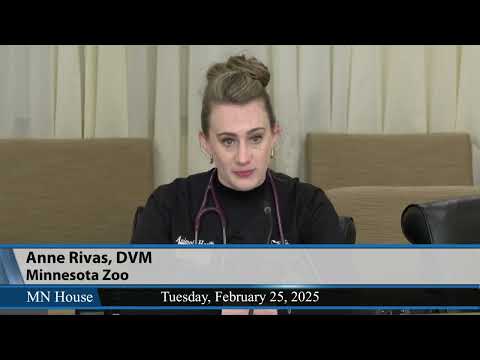
Dr. Rivas, head of the zoo’s veterinary programs, described the current hospital as the zoo’s first and oldest building, lacking ventilation, proper surgical space and an indoor ambulance/loading bay. “Our current hospital was first built in 1975 and it lacks the essential infrastructure to meet USDA and other regulatory standards in the veterinary industry,” Dr. Rivas said, adding the facility’s cramped surgical spaces and inadequate ventilation have contributed to higher surgical infection rates and unsafe working conditions.
The zoo described a proposed new hospital and wellness center with four main components: clinical capacity to treat the zoo’s diverse animal collection, a teaching hospital function to serve the state and nation, human-staff wellness design features aimed at improving staff mental health, and an indoor ambulance bay and safer animal holding and quarantine spaces. Frawley said the full hospital project is a roughly $30,000,000 undertaking; the zoo has raised about $9,000,000 privately toward it.
Committee members asked about funding priorities and partner contributions. Frawley said the treetop trail project was advanced largely because a private donor provided an initial $10,000,000 gift; state matching and donor-driven projects affect sequencing of work. On asset preservation, Frawley said boilers and heating systems are immediate priorities after a temporary $850,000 emergency repair on an aging boiler.
On workforce and training, Dr. Rivas described partnerships with the University of Minnesota College of Veterinary Medicine and the Minnesota Veterinary Association that the zoo uses to host residents, students and continuing education. She said the zoo hopes the hospital will expand training capacity and provide statewide clinical support for veterinarians working with nontraditional species.
Frawley and Dr. Rivas emphasized timeline and urgency: the zoo has worked on the hospital project for roughly five years and faces daily operational stress because the existing space is no longer fit-for-purpose.
The committee did not record a formal vote on the zoo’s request during the presentation. Members indicated support for the zoo’s mission and asked follow-up questions on funding, timeline and priorities.
Ending: The Minnesota Zoo’s presentation concluded with committee members thanking staff and volunteers; the zoo left the committee with a request for bonding to support a new teaching-capable hospital and several million dollars of asset preservation needs.