Get Full Government Meeting Transcripts, Videos, & Alerts Forever!
Get email alerts on the Corporate Governance topic
No spam. Unsubscribe anytime.
Committee advances Business Corporations Act update to general register
Summary
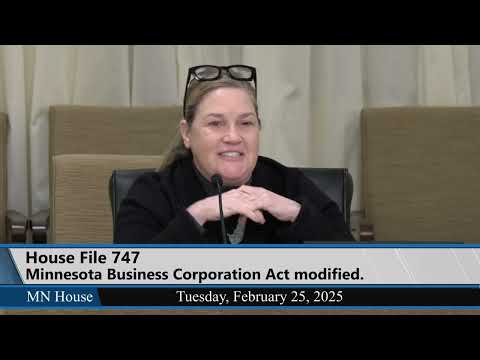
The Judiciary Finance and Civil Law Committee recommended House File 747 for passage and placement on the general register after testimony from the Minnesota State Bar Association about modernizing corporate governance rules.
The Judiciary Finance and Civil Law Committee voted by voice to recommend House File 747, a package of updates to Minnesota's Business Corporations Act, to pass and be placed on the general register.
The bill, described to the committee as originating from the Minnesota State Bar Association, would update multiple internal-governance rules to align Minnesota's corporate law with recent developments in the Model Business Corporations Act and practices in Delaware, a leading jurisdiction for corporate law. Representative Niska moved the bill and the committee approved it by voice vote.
Kim Lowe, a business-law practitioner and member of the Minnesota State Bar Association Business Law Commission, told the committee the changes affect "the internal affairs of a business, not the external affairs." She summarized major provisions the drafting group recommended, including creating statutory provisions for emergency powers to allow boards and shareholders to act during emergencies and adding a mechanism for correcting "defective" corporate acts such as historical mismatches between authorized and issued shares.
Lowe said the emergency-powers language is intended to help corporations govern during crises (for example, by allowing remote shareholder or director action when bylaws have not already addressed an emergency) and that the defective-acts provision would provide a statutory mechanism to correct longstanding drafting mistakes. She also said the bill clarifies how beneficial owners of shares held in trusts can receive information.
Committee members focused on a dense provision in Section 21 allowing a plan of merger or exchange to provide for appointment of a shareholder representative to act on behalf of shareholders whose purchase rights are cancelled in a merger. Representative Liebling and other members asked whether that language could unintentionally deprive dissenting shareholders of rights. Lowe and Majority Leader Niska described the provision as a remedial, Delaware-derived mechanism that permits appointment of a representative to ensure shareholders have enforceable representation after a merger plan is approved.
After the discussion the committee approved the bill and sent it to the general register.
The committee record does not show a roll-call tally; the clerk recorded a voice vote and the chair announced the bill was "on its way to the general register."