Get Full Government Meeting Transcripts, Videos, & Alerts Forever!
Get email alerts on the Bioenergy Woody Biomass topic
No spam. Unsubscribe anytime.
House committee advances bill to classify woody biomass and discarded wood as "carbon-free" for electricity
Summary
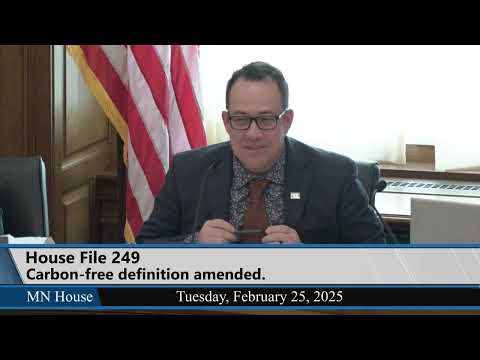
A Minnesota House committee voted to place House File 249 on the general register after adopting an author's amendment that would expand the state's "carbon-free" electricity definition to include limbs, branches and other byproducts of timber harvesting, plus discarded wood products.
A Minnesota House committee voted to place House File 249 on the general register after adopting an author's amendment that would expand the state's "carbon-free" electricity definition to include limbs, branches and other byproducts of timber harvesting, plus discarded wood products.
Supporters told the committee the change would create markets for otherwise wasted woody material, help forest management and support rural timber jobs; opponents said burning wood emits carbon and other pollutants and argued the 2023 law defining "carbon-free" electricity excludes technologies that emit carbon dioxide.
Representative Igo, who sponsored the bill, opened debate with an author's amendment that he said "just strikes line 1.1 out and replaces it" and removes a 50% threshold to make the bill clearer for presentation. After a voice vote to adopt the amendment, Igo described the measure as "getting at the carbon free definition" and said it would ensure "Minnesotans have access to safe, reliable, and affordable energy." He said the bill would cover "limbs, branches and other byproducts of timber harvesting operations, conducted for to obtain wood for non energy purposes," and would not allow clear-cutting for energy production.
Industry witnesses said markets for woody residuals are limited and that designating such materials as carbon-free would encourage utilities to convert some coal-fired plants to burn forest residue. Ray Higgins of the Minnesota Timber Producers Association told the committee that material now "sit[s] in the yards or they're paying tipping fees in our landfills" and argued that "carbon from forest biomass generated from management is already being emitted right now either through decay or as fuel for wildfires." Tom McCabe, owner of McCabe Forest Products, said selling biomass improves tight profit margins and can reduce fire danger. Rick Horton, executive vice president of Minnesota Forest Industries, said woody biomass "can provide reliable dispatchable base load power from a source that is renewable and sustainable."
Witnesses from the timber industry also pointed to state forestry practices and management guidelines. McCabe said businesses follow biomass-harvesting guidelines created by the Minnesota Forest Resources Council, and Higgins cited a recent study by that council as consistent with using forest residue for energy.
Opposition testimony emphasized statutory language and air-quality concerns. Sarah Meridi, government relations and policy director for the nonprofit CURE, said the 2023 100% carbon-free law "explicitly states that carbon free means a technology that generates electricity without emitting carbon dioxide," and argued "the combustion of wood chips or any biomass with feedstock emits carbon dioxide." Meridi also warned the bill's inclusion of "discarded wood products" could enable combustion of treated lumber that would release additional toxic pollutants.
Several committee members pressed witnesses on timing of carbon sequestration and emissions. Representative Kraft asked about decay timelines, noting estimates could be "tens of years, probably 40 to 70 depending on the environment," and Horton replied that decay rates vary by species and environment. Representative Jones and others pressed on whether the bill's primary problem statement was lack of markets and whether other local uses (for example district energy) already use woody fuels.
Representative Acum said the bill "can't be called carbon free if it is" emitting carbon during combustion and urged members to vote no. Representative Weiner and other supporters responded that the proposal would repurpose material now treated as waste and help local industries and housing-material supply chains.
After debate, Representative Igo renewed his motion that House File 249, as amended, "be placed on the general register." The committee approved the motion by voice vote. The committee also adopted Igo's author's amendment earlier in the hearing by voice vote.
The committee action places House File 249 on the general register for further floor consideration; no final enactment occurred at the hearing.