Get Full Government Meeting Transcripts, Videos, & Alerts Forever!
Get email alerts on the Education Tax Credit topic
No spam. Unsubscribe anytime.
Minn. bill would let low-income families get up to half of K–12 education tax credit up front and end assignment program
Summary
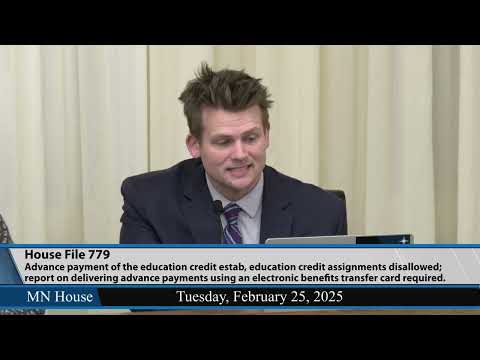
Representative (bill author and committee chair) introduced House File 779 in committee on reports of fraud tied to third‑party tutoring providers and asked the panel to lay the bill over for further work and a fiscal note.
Representative (bill author and committee chair) introduced House File 779 in committee on reports of fraud tied to third‑party tutoring providers and asked the panel to lay the bill over for further work and a fiscal note. The measure would let qualifying lower‑income families request an advance of up to half of their eligible K–12 education tax credit and would end the current credit‑assignment program; the bill also directs study of delivering the credit via an electronic benefits transfer (EBT) card rather than through third parties.
The proposal responds to reporting by Sahan Journal and the Minnesota Reformer documenting schemes in which families were recruited into tutoring programs that provided substandard instruction while third‑party organizations collected tax‑credit payments. “Cut the middleman out, educate the parents directly,” said Afshir Omar, a testifier, arguing the advance would let parents pay providers directly and avoid intermediaries who have been accused of diverting refunds. Testimony also cited the Feeding Our Future investigation as an earlier example of fraud tied to intermediaries.
Supporters said the bill aims to reduce the financial barrier that prevents some families from paying upfront for tutoring and to remove the assignment mechanism that critics say enabled fraud. “Families got ripped off here,” said Matt Shaver, senior policy director at Ed Allies, who urged the Legislature to raise the quality standards for tutoring that can qualify for the credit so that predators find it harder to operate. Shaver recommended requirements such as smaller caseloads per tutor, frequent progress reporting, alignment with grade‑level standards and paying tutors at least minimum wage.
Nonpartisan House Research staff told the committee the Department of Revenue’s available data show about 287 credits had been assigned since 2021; staff did not provide a total dollar amount. Representative Sensora (committee member) and Representative Lee asked whether the tax‑credit path is the best way to scale tutoring statewide or whether direct state investment and a vetted marketplace of providers might better ensure program quality and access for families who lack cash up front.
Committee members also raised questions about oversight and downstream consequences. Members asked whether Minnesota Department of Education (MDE) certification would be required for providers and how advance payments might affect eligibility for means‑tested benefit programs such as SNAP. Sean Williams, nonpartisan House Research staff, said determinations about whether advance payments count as income for benefit programs are complex and depend on federal guidance; the child tax credit advance payments have been treated differently in SNAP calculations, and the bill’s designers would need to examine those rules.
The bill’s sponsor described the advance as a partial mitigation of risk — a 50% advance lowers families’ exposure if something goes wrong — and asked colleagues to help refine certification and consumer protections as the bill is worked on. With no final action on policy details, the chair laid the bill over for possible inclusion in an omnibus bill or for future committee consideration; a fiscal note and additional stakeholder consultation were expected if work continues.