Get Full Government Meeting Transcripts, Videos, & Alerts Forever!
Get email alerts on the Criminal Justice topic
No spam. Unsubscribe anytime.
Senate Republicans unveil public-safety package seeking MRRA repeal, sentencing transparency and restored training funding
Summary
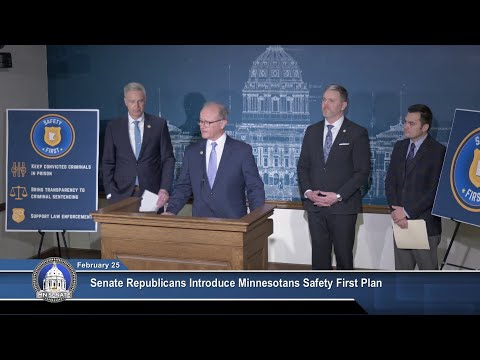
Senate Republican leader Mark Johnson and several GOP state senators on Monday outlined a public-safety package that would repeal the Minnesota Rehabilitation and Reinvestment Act, change how the Minnesota Sentencing Guidelines Commission operates and restore funding for a law-enforcement training fund created after the 2016 fatal shooting of Philando Castile.
Senate Republican leader Mark Johnson and several GOP state senators on Monday outlined a public-safety package that would repeal the Minnesota Rehabilitation and Reinvestment Act, change how the Minnesota Sentencing Guidelines Commission operates and restore funding for a law-enforcement training fund created after the 2016 fatal shooting of Philando Castile.
"We're here today to talk about the next part of our Minnesota First plan," Johnson said, opening the event and framing the proposals as measures to "put Minnesotans first" by keeping criminals in prison and "supporting our law enforcement."
Senator Michael Croon, R–District 32, said his bill "would repeal the Minnesota Rehabilitation and Reinvestment Act," and argued the law reduced time-to-parole eligibility from two-thirds of a sentence to one-half. Croon said the MRRA was applied retroactively and claimed it "puts 92 percent of Minnesota's prison population on a path to early release," and cited an example he said affected juveniles, saying the change cut some 25-year terms to 15 years.
"Repealing the M.R.R.A. and finding bipartisan compromise is how we tell Minnesotans that we are putting their safety first," Croon said.
Senator Warren Limmer, the ranking member of the Senate Judiciary and Public Safety Committee, described a separate effort to add transparency and legislative oversight to the Minnesota Sentencing Guidelines Commission. Limmer said the commission, which he said was originally intended as an advisory body, has acquired authority over sentencing changes and now effectively makes policy without affirmative legislative votes. His package would require recorded public meetings, a publicly searchable statewide database of sentences and a legislative affirmative-vote requirement to adopt commission recommendations.
"These bills today will bring transparency to criminal sentences in our state," Limmer said, adding that he believes the legislative branch "represents the voice of the people" and should have primary responsibility for writing criminal law and sentences.
A third element of the package was presented by a senator identified in the transcript as Senator Duckworth, who cited the 2016 shooting of Philando Castile and the bipartisan law that created a fund for law-enforcement training. Duckworth said the governor's most recent budget omitted continued funding for the Philando Castile training initiative and introduced a bipartisan bill to restore the fund at "its customary amount of $6,000,000 annually." Duckworth also said the package proposes an additional $3,500,000 for violent-crime enforcement training.
"It ensures law enforcement are prepared for the wide variety of situations they encounter, including use of force, crisis response management, conflict management, and community engagement," Duckworth said of the training funding proposal.
Speakers at the event urged bipartisan support for the proposals, with Johnson saying they would be "looking for co-authors on these." When asked whether Croon's repeal would carry a fiscal note, Croon acknowledged the original MRRA had fiscal implications and said changing course could have costs but reiterated the policy rationale for his repeal.
No formal motions or votes were recorded during the event. The discussion centered on outlining proposed legislation and seeking bipartisan co-sponsorship and support.
The proposals touch on multiple parts of Minnesota criminal-justice policy: reversing provisions of the Minnesota Rehabilitation and Reinvestment Act, modifying the role and transparency of the Sentencing Guidelines Commission, and restoring or augmenting training funds established after high-profile officer-involved shootings. The senators said they would move quickly on rollout and seek bipartisan cooperation as bills are introduced.