Get Full Government Meeting Transcripts, Videos, & Alerts Forever!
Get email alerts on the Biomass Energy topic
No spam. Unsubscribe anytime.
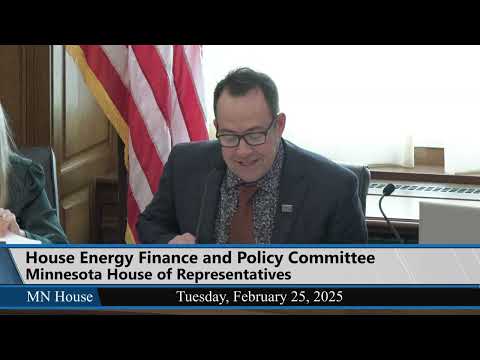
Minn. committee advances bill to classify woody biomass as 'carbon free' and put it on general register
Summary
The House Committee on Energy, Finance and Policy voted to place House File 249 on the general register after adopting an author's amendment that removed a 50% threshold and clarified which woody residues can qualify as "carbon free."
The House Committee on Energy, Finance and Policy voted to place House File 249 on the general register after adopting an author's amendment that removed a 50% line from the bill and clarified the definition of eligible woody material.
The bill, introduced by Representative Igoe, would designate certain wood residuals — including tops, limbs and other logging byproducts and some discarded wood products — as eligible under a “carbon free” definition used for Minnesota energy policy. Representative Igoe said the change is intended to create markets for material that is currently landfilled or left to decay, reduce fire risk and support rural timber businesses.
Proponents from the timber and forest-products industry told the committee the bill would help utilities convert some facilities from coal to wood-residue fuels, create rural jobs and encourage better forest-health management. Ray Higgins of the Minnesota Timber Producers Association said material left to decay “is already decaying, emitting all of their carbon either this year or next,” and argued Minnesota forest dynamics make local studies more relevant than research from other regions. Tom McCabe of McCabe Forest Products said having markets for chip material is “critical to the success of my business and many others” and helps reduce fire danger. Rick Horton of Minnesota Forest Industries testified that woody biomass can provide “reliable dispatchable base load power” and that using residue markets supports the broader forest products economy.
Opponents, including Sarah Meridi of Clean Up the River Environment (CURE), told the committee that the state’s 2023 law defining “carbon free” electricity requires generation that does not emit carbon dioxide and that combustion of woody biomass produces CO2. Meridi said life-cycle analyses can show higher greenhouse-gas emissions for some biomass energy pathways and called out potential air-pollutant and toxic-emissions risks if treated or contaminated wood were allowed under the bill’s “discarded wood products” language.
Committee members pressed both sides on timescales for carbon sequestration and the life-cycle dynamics of forest carbon. Representative Kraft and others noted that while wood is renewable over decades, the period required to re-sequester carbon can be several decades depending on species and conditions — a timeline some members said is relevant to near-term climate goals. Representative Igoe and industry testifiers emphasized that the bill targets residual material already removed from markets and not whole-tree harvests for energy.
Representative Igoe offered an author’s amendment that struck the bill’s original line 1.1 to remove a 50% threshold and clarified the bill’s language; the committee adopted the amendment by voice. Representative Igoe then renewed his motion to place House File 249 on the general register; the chair took a voice vote and the motion prevailed.
The bill now moves to the next steps in the House process with its amended language. Committee minutes indicate the action was by voice vote; no roll-call tally was recorded in the transcript.
Votes at a glance: House File 249 (author’s amendment adopted by voice; bill placed on general register by voice vote).
Members and witnesses who spoke during the item included Representative Igoe (bill author), Ray Higgins (Minnesota Timber Producers Association), Tom McCabe (McCabe Forest Products), Rod Edinburg (Edinburg Logging), Rick Horton (Minnesota Forest Industries), and Sarah Meridi (CURE).