Get Full Government Meeting Transcripts, Videos, & Alerts Forever!
Get email alerts on the Housing Affordability topic
No spam. Unsubscribe anytime.
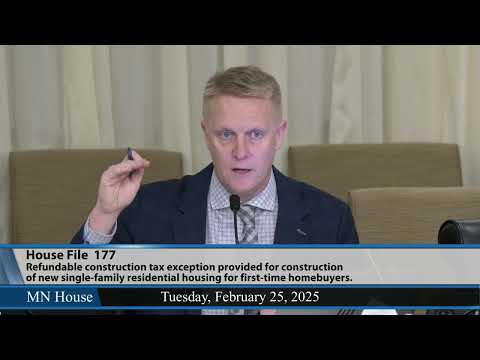
Committee refers House File 177 to taxes after debate on sales-tax exemption for starter homes
Summary
The Minnesota House Committee on Housing Finance and Policy voted to refer House File 177 to the Committee on Taxes after adopting an author's amendment that caps a proposed sales-tax exemption on construction materials and clarifies intent to target first-time homebuyers and starter homes.
The Minnesota House Committee on Housing Finance and Policy on Feb. 19 voted to refer House File 177 to the Committee on Taxes after adopting an amendment that lowers the exemption cap and clarifies how savings should be passed to homebuyers.
The bill, carried by Representative Myers, would exempt a portion of sales tax on construction materials used to build single-family homes intended for first-time homebuyers. An author’s A-1 amendment, adopted in committee, set a cap that the author described as roughly $165,000 of exempted materials on a $500,000 home and included language intended to ensure builders pass savings to buyers. Chair Igoe moved the referral; the committee advanced the bill by voice vote.
Proponents said the exemption could make modest but meaningful reductions in purchase costs. Mark Foster, vice president of legislative and political affairs for Housing First Minnesota, told the committee that a builder’s model — a 1,600-square-foot rambler — would yield about $9,000–$10,000 in savings if materials were exempted from sales tax. “For every $1,000 in cost savings, approximately 2,500 more Minnesota families can afford that home,” Foster said, and called for continued work on draft language so builders are not caught “in between the buyers and then the sales tax exemption.”
Committee members pressed the author on design details and targeting. Representative Verouer asked whether higher‑priced homes might also receive the benefit; Myers said the amendment is intended to cap eligibility so the benefit would not apply to very high‑priced homes. Several members asked whether income or other targeting should be added to ensure the savings reach typical starter‑home buyers and to prevent quick resale or conversion to nonowner occupancy. Nonpartisan staff clarified that, as drafted, the bill does not require a minimum occupancy period for owners who occupy a unit.
Members also sought fiscal information. Representative Lee Howard and others noted they had requested a fiscal note; Myers said a fiscal note had been requested and that an updated estimate was pending. Nonpartisan staff explained the exemption would create a general‑fund impact when sales‑tax refunds are paid out and that local aid formulas would not be directly affected; locally assessed taxes, however, could see reduced revenue where local sales taxes apply.
Several members sought clarity on administration and timing. The bill treats the exemption as applying to construction materials only, not labor, and envisions a process in which builders document qualifying first‑time homebuyers and seek reimbursement through the Department of Revenue. Nonpartisan staff said refundable exemptions are easier for the Department of Revenue to track than upfront exemptions.
The committee adopted the author’s amendment and re‑referred House File 177 to the Committee on Taxes by voice vote. The bill includes a sunset provision noted in the draft (transcript reference: “sunset clause in there to 02/1933”); members signaled further drafting and fiscal analysis would continue before action in the tax committee.
A referral does not enact policy; it sends the bill to the next committee for further review and, if appropriate, additional amendments and fiscal analysis.