
Maryland lawmakers debate expanding schools’ reportable‑offense notifications after Harford County murder case
Get AI-powered insights, summaries, and transcripts
Sign Up Free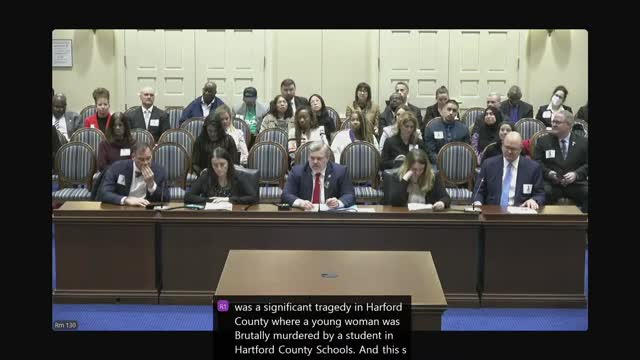
Summary
A House committee on Tuesday debated proposals that would let prosecutors notify school superintendents earlier when juveniles are suspects in the most serious crimes, after a high‑profile murder case in Harford County exposed notification gaps.
A House committee on Tuesday debated a set of bills that would change how and when school systems are notified about juvenile involvement in serious crimes, prompted by the 2022 murder of Kayla Hamilton in Harford County.
Supporters — including Harford County State—s Attorney Allison Healy and Harford County Superintendent Sean Bolsom — urged lawmakers to give prosecutors discretion to notify school superintendents when a juvenile is a suspect in a murder or other violent felony. “It allows state's attorneys to use discretion as to the reporting of these matters and to reserve it for cases where there is a true potential danger to students and the school system,” Healy told the committee.
Proponents said the narrow proposal would address gaps that left school leaders unaware of threats. “None of the agencies that the student encountered . . . had any obligation or more importantly, any authority to share these really unusual circumstances with us,” Harford County Superintendent Sean Bolsom testified, describing a suspect who enrolled in a county high school while under investigation.
Family members of victims likewise urged action. Tammy Nobles, mother of Kayla Hamilton, described how a suspect was allowed into schools while investigation delays persisted: “If the state's attorney or the police station would have been able to share the level of threat . . . then they could have done something to make sure he wasn't around other vulnerable populations such as students,” Nobles said.
Opponents pressed legal and equity concerns. Abby Flanagan of the Maryland Office of the Public Defender and Levi Bradford of the Public Justice Center argued that allowing notification when a juvenile is only a suspect risks violating due process and could expose students to school discipline before charges or adjudication. “Altering a student's right to education based solely on police suspicion is an overreach of the government's authority,” Flanagan said. Bradford added that expanding reportable offenses will likely exacerbate racial disparities already present in school disciplinary and arrest data.
Witnesses also disagreed over whether to expand the list of reportable offenses. Supporters pointed to specific gaps (for example, newer technology‑enabled crimes) and asked for narrowly tailored additions; critics argued the current law already covers many offenses and that the statute is applied unevenly across jurisdictions.
Committee members identified two recurring policy tradeoffs: protecting students and staff by sharing timely information about serious threats, versus protecting juveniles’ procedural rights and preventing school exclusion based on suspicion alone. Several members urged more study or a narrower, carefully circumscribed approach. The hearing produced no committee vote; sponsors said they were open to amendments and workgroup discussions.
The bills discussed included language authorizing a state's attorney to notify a superintendent or the superintendent's designee when a juvenile is a suspect in first‑ or second‑degree murder or a violent felony, and separate measures to update the list of reportable offenses and close gaps in how schools are notified when juvenile cases are handled informally by the Department of Juvenile Services.