Get Full Government Meeting Transcripts, Videos, & Alerts Forever!
Get email alerts on the Zoning Land Use topic
No spam. Unsubscribe anytime.
Woodford County holds public comment on zoning changes aimed at curbing in‑family conveyance and protecting farmland
Summary
The Woodford County Fiscal Court heard more than an hour of public comment on proposed amendments to Articles 2 and 7 of the zoning ordinance that would tighten in‑family conveyance rules and change rural residential standards; no vote was taken and the ordinance committee must first refer any changes to the full court.
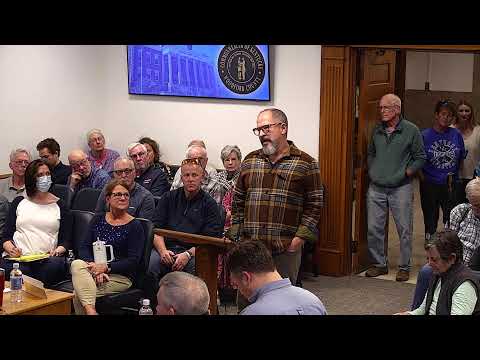
The Woodford County Fiscal Court convened a public comment session on a proposed zoning text amendment to Articles 2 and 7 of the county zoning ordinance, drawing dozens of residents who both supported and opposed the changes. The judge said the session was for input only and that the court would not vote on the amendment that evening.
The proposed text amendments grew out of deliberations by the Planning and Zoning Commission, the Agriculture Advisory Review Committee and the county’s Ordinance Committee. County officials recited a months‑long procedural history, including a Planning Commission public hearing on Dec. 19, 2024, and multiple advisory meetings dating to 2023. The judge told attendees the ordinance must be voted out of the Ordinance Committee before action by the full fiscal court.
Speakers who supported the revisions — many identifying as farmers, members of the Agriculture Review Committee, or longtime residents — said the amendments are necessary to prevent perceived abuses of the in‑family conveyance provision and to preserve the county’s agricultural economy and viewshed. "It was a great idea to help family members stay on the farm. Unfortunately, most of the in family conveyance slots were sold at 5 years or earlier," Bea Stringer said, urging adoption of the changes she helped draft.
Other residents, including several who described themselves as third‑generation county families, urged the court to preserve in‑family conveyance rights so landowners can keep children and grandchildren nearby. "My grandfather fought and bled and begged and borrowed to buy as much land as he possibly could because he knew how important land was," said Julie Reed, who said her family used in‑family conveyance to keep multiple generations together and asked the court to retain avenues for family succession.
Concerns raised during public comment included: potential loss of affordable housing if rural residential options are restricted (one speaker noted a current local need for roughly 1,200 affordable houses); increased lot sizes from provisions described by speakers as doubling minimums to two‑acre lots; a proposed maximum dwelling height of 42 feet; infrastructure impacts on roads, water and septic systems; and the loss of agricultural support businesses if farmland is subdivided.
Supporters pointed to the economic interdependence of farms and local businesses, saying parcelization of prime farmland would harm a broad agricultural cluster that includes feed stores, equipment repair, fencing and caterers. "When the land is converted from ag production to non‑ag uses into smaller and smaller parcels, the ag economic cluster falters and ultimately fails," said Lori Garkovich of the Agriculture Advisory Review Committee.
Planning and zoning staff and committee members told the court the county has already tried targeted measures (cluster development, a 30‑acre minimum in some agricultural districts) and that the proposed text amendments are an attempt to close loopholes seen in practice — notably how some parcels conveyed under the in‑family provision were later sold. County Attorney clarified that Midway does not operate a separate opioid recovery program (clarification made during the earlier Net Recovery discussion) and reiterated procedural requirements for ordinance review.
The judge told the public that magistrates are available to discuss the amendments individually and encouraged written comments; he reiterated there would be no vote that evening and that the Ordinance Committee must report the proposal to the fiscal court before any final action.
Public comment continued with roughly 20 speakers signed up; testimony cited multiple sites and specific local roads where previous parcelization has occurred and asked the court either to adopt the proposed ordinance changes or to refine them to allow some family conveyance while preventing commercial subdivision through the in‑family channel.