Get Full Government Meeting Transcripts, Videos, & Alerts Forever!
Get email alerts on the Federal Policy And Budget topic
No spam. Unsubscribe anytime.
Multnomah County briefed on federal executive orders, budget risks; staff to map $250M in federal funds
Summary
County staff and federal lobbyists told commissioners that recent executive orders, active litigation and reconciliation plans could affect federal grants and programs that support county services; staff will compile detailed funding inventories and follow up on Medicaid and housing impacts.
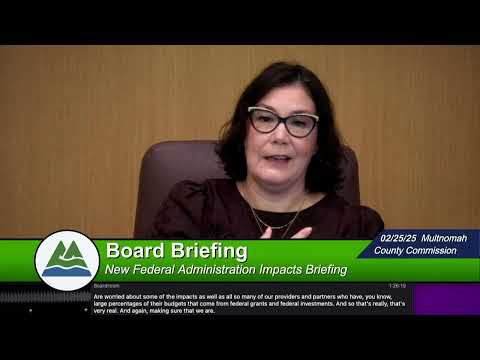
Multnomah County officials and outside federal lobbyists briefed the Board of County Commissioners on the changing federal policy and budget landscape and the potential local impacts, and said county staff will assemble detailed funding inventories and follow up with state and federal partners on program-level risks.
Vicky Kram, partner at Thorn Run Partners, told the board the new administration’s early executive orders, pending lawsuits and a narrow congressional majority make outcomes uncertain and could disrupt grants and federal program implementation. “We are pleased to appear before you today to discuss what we know and also much of what we don't know about the new Trump administration and the 119th Congress,” Kram said. She warned that some Inflation Reduction Act (IRA) and infrastructure-related funds have been held up and that litigation and court stays are shaping which orders take effect.
The briefing outlined three main risk channels: executive actions (including orders on sanctuary jurisdictions and programs with diversity, equity and inclusion components), the reconciliation process in Congress that could change tax incentives and benefits, and the annual appropriations process, where continuing resolutions and sequestration could impose across-the-board cuts. Pamela Lowell, who spoke on congressional budget processes, noted the reconciliation route could be used to extend 2017 tax changes and to pursue major domestic spending cuts, and she flagged possible changes that would affect counties such as the tax status of municipal bonds and the low-income housing tax credit.
Why it matters: County programs and community partners receive substantial federal support for healthcare, housing, human services and infrastructure. Justin Black, deputy chief operating officer, said the county is already building an internal work group and communications hub to monitor federal directives, coordinate department responses and provide guidance to staff and community partners. “We’ve had a lot of hurry up, stop, back up, wait,” Black said, describing the cadence of directives followed by court actions.
Key details and staff commitments
- County staff said they will compile and share a detailed inventory of federal funding, including the county’s SEFA (Single Audit) report. Staff estimated the county receives roughly $250,000,000 in federal dollars when passthrough funds are included, and said they will provide exact figures. Justin Black presented the work plan for a cross-departmental group that will monitor executive orders, agency directives and litigation and act as a central conduit for department questions and guidance.
- On program risks, Kram and Pamela Lowell highlighted several items to watch: potential restrictions on federal funding for jurisdictions deemed noncompliant with federal immigration enforcement, litigation over orders targeting DEI programs, partial holds on IRA disbursements, and possible reconciliation-driven changes to municipal bond tax treatment, private activity bonds, child tax credits, low-income housing tax credits (LIHTC), new markets tax credits and safety-net programs such as SNAP and TANF.
- Commissioners asked for program-level analyses. Commissioner Moyer (District 1) sought clarity on Medicaid-related proposals, particularly proposals that would impose work requirements and how those would affect dual-eligibles or people receiving long-term care. Staff committed to follow up with the Oregon Health Authority and with Thorn Run Partners to clarify which Medicaid populations could be affected.
- Commissioners also asked for a list of grants and pending or planned federal applications. Commissioner Singleton asked specifically whether planned infrastructure proposals—such as earthquake-ready bridge projects—rely on grants that might be at risk; staff said they will compile an expected-grants list, including project-level dependencies.
Equity, housing and coalition building
Several commissioners emphasized equity and housing concerns. One commissioner asked that county budget planning include equity impact analysis to identify how cuts would affect BIPOC communities and people with disabilities. Kram and county staff said they will coordinate with Oregon’s congressional delegation, the Oregon Attorney General’s Office, the Oregon Nonprofit Association and associations of counties to pursue joint advocacy. Pamela Lowell said there may also be opportunities if Congress expands LIHTC and other housing measures, but that such expansions could trade off with cuts elsewhere.
Next steps and follow-up
County staff said they will: (1) deliver the SEFA-based inventory and an itemized list of federal funds that flow to county programs and contractors; (2) follow up with the Oregon Health Authority on Medicaid proposal details and potential impacts; (3) coordinate with Thorn Run Partners on likely reconciliation scenarios that would affect municipal bonds, LIHTC and other county-relevant programs; and (4) continue regular communications with the board as actionable items arise. The board was also told the county will continue coordinating with statewide and national county associations for coalition advocacy.
The briefing concluded with a reminder that federal funding uncertainty is evolving and that staff will return with more detailed analyses and updates. The board adjourned and noted a joint city–county briefing scheduled for the following day in the Portland City Council chambers.