Get Full Government Meeting Transcripts, Videos, & Alerts Forever!
Get email alerts on the School Budget topic
No spam. Unsubscribe anytime.
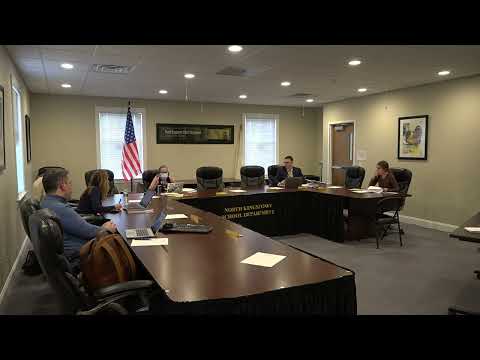
Advisory committee reviews North Kingstown FY26 school budget; urges reports on CES, turf and $750,000 plan
Summary
The North Kingstown Budget and Finance Advisory Committee on Feb. 24 reviewed a draft fiscal year 2026 school budget that reduces projected operating costs by repurposing enterprise funds, seeks a lower-cost school fiscal software option and asks the superintendent to deliver three follow-up reports: an evaluation of the district—s "CES designation," an analysis of the turf and track replacement timeline and costs, and a plan to find $750,000 in operating savings or revenue by Oct. 1.
The North Kingstown Budget and Finance Advisory Committee on Feb. 24 reviewed a draft fiscal year 2026 school budget that reduces projected operating costs by repurposing enterprise funds, seeks a lower-cost school fiscal software option and asks the superintendent to deliver three follow-up reports: an evaluation of the district—s "CES designation," an analysis of the turf and track replacement timeline and costs, and a plan to find $750,000 in operating savings or revenue by Oct. 1.
Leslie (hall director), who presented the draft budget changes, said the committee—s recommended switch of the district—s fiscal software could cut annual software costs from "upwards of a hundred and $80,000 a year" to an estimated $55,000 to $75,000 if the district migrates within Tyler Technologies to a school-specific ERP. She told the committee the transition would be charged at the lower rate once the school committee approves the change and recommended placing implementation costs in capital rather than the operating budget.
The draft also reclassified a diversity, equity and inclusion coordinator into a different administrative bucket, corrected dental-benefit calculations with a more recent data pull, and adjusted several position and benefit line items to more precisely reflect FTE counts year over year. The presentation noted administrative FTEs moved from a reported 30 to 29 in one category as part of that reclassification.
The committee discussed several enterprise-fund shifts. Presenters proposed using $30,000 from the district—s computer repair enterprise fund to buy half of an administrative laptop replacement purchase now (the total purchase was described as $60,000), with the remaining half to be purchased in FY26. The committee heard that using current enterprise funds would allow some purchases to be made in FY25 rather than wait for FY26.
On transportation, the budget removed an anticipated $46,000 lease payment for two buses because the district has purchased those vehicles and committee members discussed using surplus to buy the buses outright to avoid interest costs.
Athletics spending prompted extended debate. The presenter said gate receipts historically generate about $35,000 to $40,000 per year and proposed using up to $30,000 of recurring gate-receipt revenue for uniforms or similar recurring costs to reduce the FY26 operating ask. Opponents warned that supplanting structural operating costs with enterprise fund receipts can mask true costs and create future budget pressure if enterprise revenue falls. Committee members agreed to separate "uniforms and supplies" from equipment and to recommend using gate receipts for uniforms this year while the superintendent reviews whether equipment or other recurring athletic costs should be funded from gate receipts going forward.
Members also raised program-specific points: a sustainability coordinator position paid by a grant was discussed as temporary and not budgeted as a continuing FY26 salary unless the committee directs otherwise; a nutrition rebate from the district—s trust was reported as "not specified" for FY26 pending the trust—s calendar-year reconciliation; and the committee heard that solar credits generated by the town appear on the school district—s utility bills, resulting in a net expense line called "solar credits" that the presenter said she and district staff will review with town officials.
The advisory committee approved three formal recommendations to forward to the full school committee. At the meeting, Paul (committee member) moved and a committee member seconded a recommendation that the school committee task the superintendent to report back on the district—s "CES designation" and whether it should continue; the committee approved the recommendation by voice vote. The panel also voted to ask the superintendent to report by Sept. 1 on the status of the turf and track at MK High School, the likely replacement window, estimated replacement cost and whether the current designated fund balance is sufficient; presenters cited an original 10- to 12-year estimated life for the turf and a previously estimated replacement cost of $1,500,000. Finally, the committee voted to ask the superintendent and the advisory subcommittee to identify $750,000 in operating reductions or revenue enhancements by Oct. 1 to cover a planned fund-balance reappropriation for FY26.
None of the three recommendations recorded a roll-call vote in the advisory committee minutes included in the transcript; each passed on a voice vote with members saying "Aye." The transcript does not list individual roll-call tallies for those recommendations.
The committee set its next meeting for March 24 and adjourned after the budget discussion.