
West Perry branch highlights growth in programs, diverse patrons and new lockers; patrons praise community impact
Get AI-powered insights, summaries, and transcripts
Sign Up Free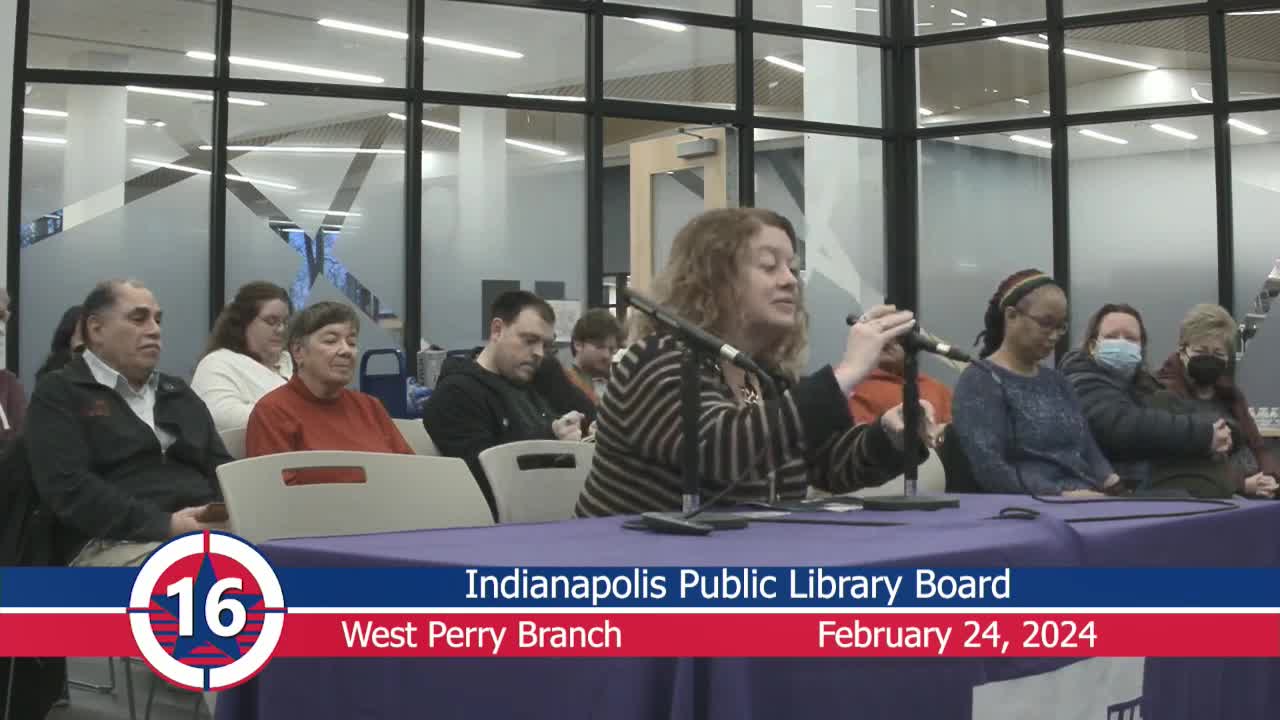
Summary
West Perry branch manager reported rising circulation and program participation, described outreach to Burmese and Chin communities, and highlighted hold lockers and study-room demand. Two public commenters described how library programs generated community connections and urged retention of physical DVDs.
The Indianapolis Public Library’s West Perry Branch reported rising use of its facilities and programs and outlined outreach to multiple language communities during the board’s Feb. 24 meeting.
The branch manager told the Board that West Perry opened on July 16, 2021, and serves a service area with about 55,197 residents, including substantial Burmese and Chin communities. “We try to reach out to all our audiences,” the manager said, noting partnerships with Perry Township Schools, the Burmese American Community Institute and Franciscan Health Network. The manager said the branch’s population is about 20% Asian, 8% Black, 10% Hispanic and 62% non-Hispanic white, and that Burmese languages are common in the neighborhood.
Branch-level statistics presented to the board showed 1,121 new registered borrowers last year, a 13% increase in physical item circulation, an 8% rise in use of the branch’s holds lockers and 308 programs with roughly 8,500 participants systemwide tied to those programs at West Perry. The manager described a mix of services: four study rooms that are heavily used, STEAM programming for homeschoolers, a teen advisory board, gardening and native-plant programs, and a “headshot studio” offered by a staff photographer. The manager said study rooms are limited to two hours per group to preserve access and that the branch uses volunteers and pages to support operations.
Public commenters said the branch’s programs generate neighborhood connections beyond attendance counts. Eileen Sandhu, who identified herself as part of “Around the Stitching Table,” told the board the group began as participants in a library meditation program and now meets weekly with about nine to 10 regulars; members donate supplies to youth and food pantries and sew for animal shelters. “It’s like a ripple effect,” Sandhu said, describing volunteers, donations and spin-off activities in the community.
Jenny Lee, a member of the West Perry Garden Club, told the board she transformed a lawn into native-plant and food gardens because of knowledge gained through the library’s garden programs. Lee urged the board to maintain physical DVDs in the collection, recounting instances when rare titles were unavailable on streaming platforms but loanable through the library. “Weird, random things that are just not streaming anywhere else are always available here,” she said.
Board president Ray Biederman opened the meeting and framed the library’s role in neighborhoods. “The Indianapolis Public Library embraces its unique position as a vital, indispensable service with a significant presence in neighborhoods across our city,” Biederman said.
The branch manager highlighted the branch’s sustainability work — native-plant beds, an “Adopt-a-Block” with Keep Indianapolis Beautiful, and partnerships with a Girl Scout troop and IMPD Southwest District — and said accessibility to internet and co-working space is stronger than at some branches because more households in the area have broadband. The branch continues to pilot “hold lockers” for after-hours pickup and to add programs that respond to neighborhood interests such as citizenship classes and gardening.
Board members asked about program attendance counting and the manager described staff and volunteers who tally attendees and how recurring participants are recorded in the library’s activities database. The board also asked about the demand for study rooms; the manager said rooms are often fully scheduled during peak times, especially around local and college finals.
The branch manager and public commenters credited library staff and volunteers for sustaining high-program quality and community connections. The presentation and comments close with the board thanking the West Perry staff for their work and acknowledging the branch’s role as a community hub.