Get Full Government Meeting Transcripts, Videos, & Alerts Forever!
Get email alerts on the Land Use Surveying topic
No spam. Unsubscribe anytime.
Committee advances bill to remove duplicate post‑annexation survey monument requirement
Summary
The House Travel, Recreation, Wildlife & Cultural Resources Committee voted to advance Senate File 171, which removes a second required survey monumentation step after annexation; proponents said it reduces cost and duplication and gives localities flexibility.
The House Travel, Recreation, Wildlife & Cultural Resources Committee voted, by roll call, to advance Senate File 171, a bill that would eliminate a statutory requirement to place survey monumentation after annexation, clearing the measure out of committee with nine aye votes.
Supporters said the change removes a redundant regulatory step that often results in unnecessary cost and work for municipalities and developers. Senator Nethercott introduced the bill and the sponsor described it as “a good little bill” aimed at cutting duplicative regulation.
Mr. Blum, a City of Cheyenne representative, told the committee that the statute requires monumentation — “those little metal posts in the corners” — after annexation but that the requirement often duplicates later work. “Typically, when a development occurs ... the next step is folks go through the entitlement to create lots, develop, identify where streets are, engineer everything,” Blum said. He added that grading and site work commonly destroy initial monuments and that state law then requires re-monumentation when a subdivision is created.
Blum said the cost of re-monumentation varies by site and can be substantial; committee testimony placed a typical cost “anywhere from $8,000 to, even higher depending on the size of the area annexed.” He and others said the requirement was added during statutory cleanup in 02/2007 and its removal would reduce duplication of effort.
The Wyoming Association of Municipalities (WAM) and the Wyoming Planning Association offered public comment in support. Paul Hall of the Wyoming Association of Municipalities said the organization had no opposition and supported the bill as a way to reduce regulation and provide local flexibility. Melissa Ruth, a member of the board of the Wyoming Planning Association, said her organization stood in support and that the change would “provide for more of that local control.” Renny McKay, president of the Wyoming Business Alliance, also thanked the committee for bringing the cleanup forward.
Representative Thayer reported consulting a city attorney who raised some concerns but said those were eased by the bill’s use of “may,” which preserves municipal discretion when a jurisdiction still wants to require a survey. Representative Wharf questioned whether the bill’s scope was large enough, noting it is only two pages; supporters said the provision is the outcome of multi-year regulatory reduction efforts and reflects where agreement was reached.
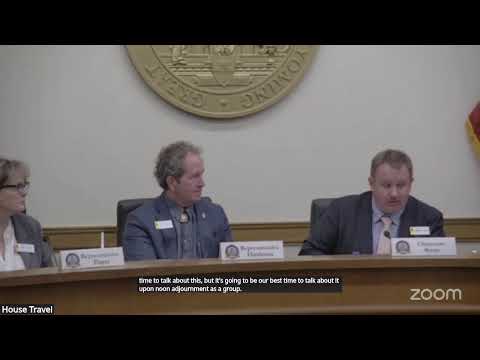
Representative Campbell moved the bill in committee; Representative Provenza seconded. A roll call returned nine ayes: Representative Campbell (aye), Representative Connolly (aye), Representative Harshman (aye), Representative Jarvis (aye), Representative Provenza (aye), Representative Storer (aye), Representative Thayer (aye), Representative Wharf (aye), and Chairman Byron (aye). Committee staff announced “there are nine aye,” and the bill cleared the committee.
No committee amendments were adopted during the session. Committee members said further changes could arise in subsequent floor debate. The committee chair noted the panel will reconvene with its Senate counterparts in a joint session to discuss interim topics, and another committee meeting is scheduled later in the week to hear one more bill.
Votes at a glance: Senate File 171 — motion to advance moved by Representative Campbell, seconded by Representative Provenza; roll call vote 9–0 in favor; outcome: advanced out of committee.