Get Full Government Meeting Transcripts, Videos, & Alerts Forever!
Get email alerts on the Mineral Trust Fund topic
No spam. Unsubscribe anytime.
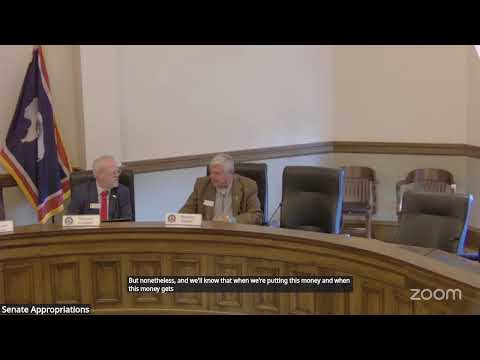
Committee hears plan to reduce permanent mineral trust spending rate to build reserve; bill laid back for further consideration
Summary
Representative Bair told the Senate Appropriations Committee that House Bill 270 would reduce the permanent mineral trust fund’s spending policy from 5% to 4.5% of a five-year earnings average, dedicating the difference to a reserve account to permit more aggressive investing.
Representative Bair presented House Bill 270 to the Appropriations Committee, explaining the measure would reduce the spending rate taken from the Permanent Mineral Trust Fund from 5% of the five-year average of earnings to 4.5%, directing the excess back into a reserve account to build toward investment thresholds that would permit more aggressive, higher-return allocations.
Bair said the statute and the reserve account were designed to allow a portion of the corpus to be invested in less liquid, higher-yield assets once the reserve reached certain multiples (a cited 5x to 7x target). He told the committee that constraining current spending would help the reserve grow and that, by one estimate, the change would reduce near-term available funds to the general fund by roughly $24 million to $28 million annually while improving long-term returns.
Committee members raised concerns about short-term revenue effects given other fiscal pressures and tax-relief proposals under consideration. Senator Groot and others asked how often the fund had underperformed the 5% threshold; Bair and staff replied recent earnings exceeded that level and that long-term averages were lower, explaining the change is intended to stabilize the reserve account’s trajectory.
Senator Hicks and staff described the mechanics: by preserving a larger reserve the state can target an illiquidity premium and chase higher total returns over time, which proponents said would create more dollars for future spending than the current policy. Committee discussion included references to historical actions that placed money into the reserve account and to options that exist in a stress scenario — including using budget footnotes or statutory suspensions to pause transfers if revenue conditions deteriorate.
Lawmakers also debated philosophical and fiscal trade-offs. Some members argued the fund’s balances represent money for current taxpayers and local backfills; others characterized it as a generational resource to be invested for long-term returns. After extended discussion, committee members agreed to lay back House Bill 270 (along with several related bills) to a future meeting so the committee chair and members can review details and obtain the chairman’s input.
Motion and committee action: a committee member moved to lay back House Bill 270, House Bill 271, House Bill 293 and House Bill 294 to the committee’s next meeting; the motion was seconded by Senator Larson and adopted. The bills will be brought back with the committee chair’s input and any requested clarifications.