Get Full Government Meeting Transcripts, Videos, & Alerts Forever!
Get email alerts on the Shacklebottom Policing topic
No spam. Unsubscribe anytime.
Police describe intensive policing in ShackleBottom after summer violence; council and businesses seek zoning and planning solutions
Summary
Chief Rick Edwards said concentrated policing in the ShackleBottom reduced violent crime this past summer but required significant manpower and produced prosecutorial challenges; council members and business leaders asked staff to explore zoning and planning options.
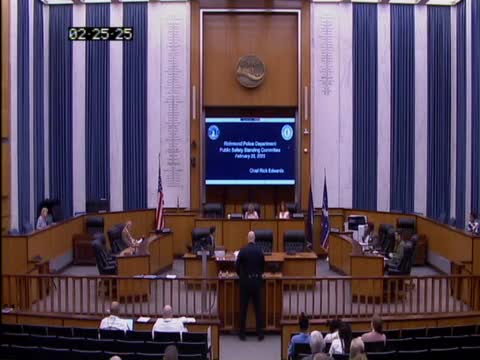
Chief Rick Edwards told the Public Safety Standing Committee that heavy policing in the ShackleBottom over the past summer produced a measurable decline in violent crime but created enforcement and prosecutorial challenges.
Edwards said concentrated attention in the area corresponded with "less shootings, less robberies, and overall violent crime drop of 12%" in the summer months, but at a cost in manpower and overtime. He told the committee that a large share of guns reported stolen from unlocked cars were taken in the ShackleBottom area and that open display of firearms in the entertainment district is common. "We seized 50 guns in a month and probably 300 guns of people walking around that were lawful. They were open carrying," he said.
The chief described a fatal shooting in the area in which an arrest followed; he also explained why a number of cases tied to public incidents were dismissed after review. Edwards said the Commonwealth's attorney asked RPD to try to determine whether a person had a concealed‑weapons permit before taking physical custody or putting hands on a suspect in some cases. "There is no case law that requires that. That is simply what the Commonwealth attorney has asked for our officers," Edwards said, describing the guidance as an interagency request rather than a statutory requirement.
Council members and business leaders pressed for policy and planning responses. Councilmembers proposed discussing zoning approaches similar to city park firearm restrictions or creating a special entertainment district with a perimeter or ID carve‑out for residents and tenants. Warren Braxton, criminal justice chair for the Richmond NAACP and a ShackleBottom business owner, said business owners support a special entertainment‑district approach so the police "can get the resources he need" and the district can be governed to balance business operation and public safety.
Committee members asked the police and planning staff to work together and to include other council members who represent the area in follow‑up meetings. The committee also noted an estimated $27,000 in overtime tied to policing the ShackleBottom during peak summer operations; Chief Edwards said that figure covered mandated overtime for details but did not include on‑duty staff costs.
Edwards warned that confrontations around firearms can escalate rapidly and cited a recent distant incident in Virginia Beach as an example of risk to officers and the public. He urged residents who feel mistreated to file complaints and noted that body‑worn camera footage and multi‑agency review shape court outcomes.
Next steps recorded at the meeting included a staff follow‑up to convene discussions with the police chief, planning staff and council members representing the ShackleBottom area; no ordinance or formal zoning change was adopted at the meeting.