Get Full Government Meeting Transcripts, Videos, & Alerts Forever!
Get email alerts on the Child Exploitation topic
No spam. Unsubscribe anytime.
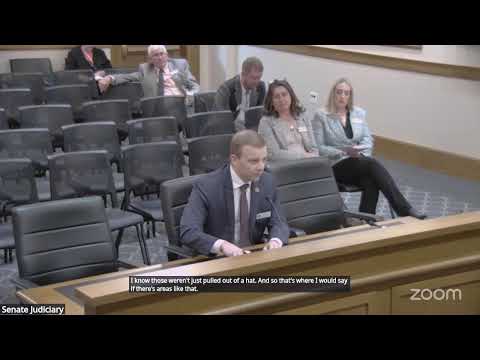
Senate Judiciary passes amendment to House Bill 171 to add chest/breast language to child‑exploitation definition
Summary
The Senate Judiciary Committee voted to pass House Bill 171, an amendment that adds language to the statutory definition of explicit conduct to include the chest or breasts of a female person; members debated whether the change should apply to any person.
The Senate Judiciary Committee on (date not specified) voted to pass House Bill 171, "Exploitation of Children Amendments," adding language to the statutory definition of what the bill’s sponsor described as "explicit ... conduct" to include the chest or breasts of a female person.
The measure, introduced by Representative Tommy Strach of House District 6, would amend the statutory definition used in child‑exploitation offenses so that a lascivious exhibition of the chest or breasts of a female person is explicitly listed among the body parts covered by the statute. "This is a bill that seeks to define more clearly the crime of ... exploitation of children by amending the definition of the term explicit ... conduct," Representative Strach said.
Committee members and staff said the change responds to at least one local investigation in Converse County in which a male taking photographs of a stepchild could not be charged under a more severe provision because the current wording did not explicitly list the body part in question. "Because it was not listed as one of the body parts, he was able to not serve any time," Strach said.
Senators debated whether the amendment should be limited to female anatomy or drafted to cover "any person." Senator Crago noted related statutes — cited in committee as 6‑4‑305 and 6‑4‑306 (as discussed during the hearing) — already address dissemination or possession of images of a minor and include, at least in some provisions, reference to the breast of a female. "If he was taking pictures of his stepchild... as long as that person was under the age of 18, that is a crime," Crago said, adding that the committee was trying to determine whether the change fills a statutory gap or duplicates existing provisions.
Senator Cobbs and others raised practical drafting questions: whether the terms "chest" and "breasts" capture undeveloped anatomy in younger children and whether language should be broadened to avoid loopholes. "If we had more encompassing language, it would be better for that purpose," Senator Cobbs said.
Public comment included one online speaker, identified to the committee as Mr. Melia, who said he worked in public health and supported the bill and urged broader societal action to protect minors. "I totally support it...We want to protect our children from this," Melia said, and suggested additional, separate measures aimed at adult‑oriented retailers.
Committee staff and members agreed on a narrowly technical amendment to the bill’s definition to remove a redundant conjunction and tighten punctuation in the list of body parts. The committee then moved the bill for passage with the amendment.
Roll call on House Bill 171 recorded four "aye" votes: Senator Crago, Senator Crum, Senator Kohl and Chairman Olsen; Senator Hicks was recorded as excused. The committee reported the bill "do pass amended." The chair announced the bill’s floor manager would be a senator identified on the bill paperwork.
The discussion in committee kept a distinction between drafting and intention: sponsors and some members said the measure addresses prosecutorial practicality in a particular case, while other members urged broader drafting to avoid excluding certain victims by anatomical description. The committee did not add broader gender‑neutral language during this hearing.
With the committee’s approval, the bill proceeds to the floor for further consideration and any additional amendments.