Get Full Government Meeting Transcripts, Videos, & Alerts Forever!
Get email alerts on the Transportation topic
No spam. Unsubscribe anytime.
Rockville work session details EV readiness plan; council favors vendor- and infrastructure-driven options, accessibility and cost-recovery pricing
Summary
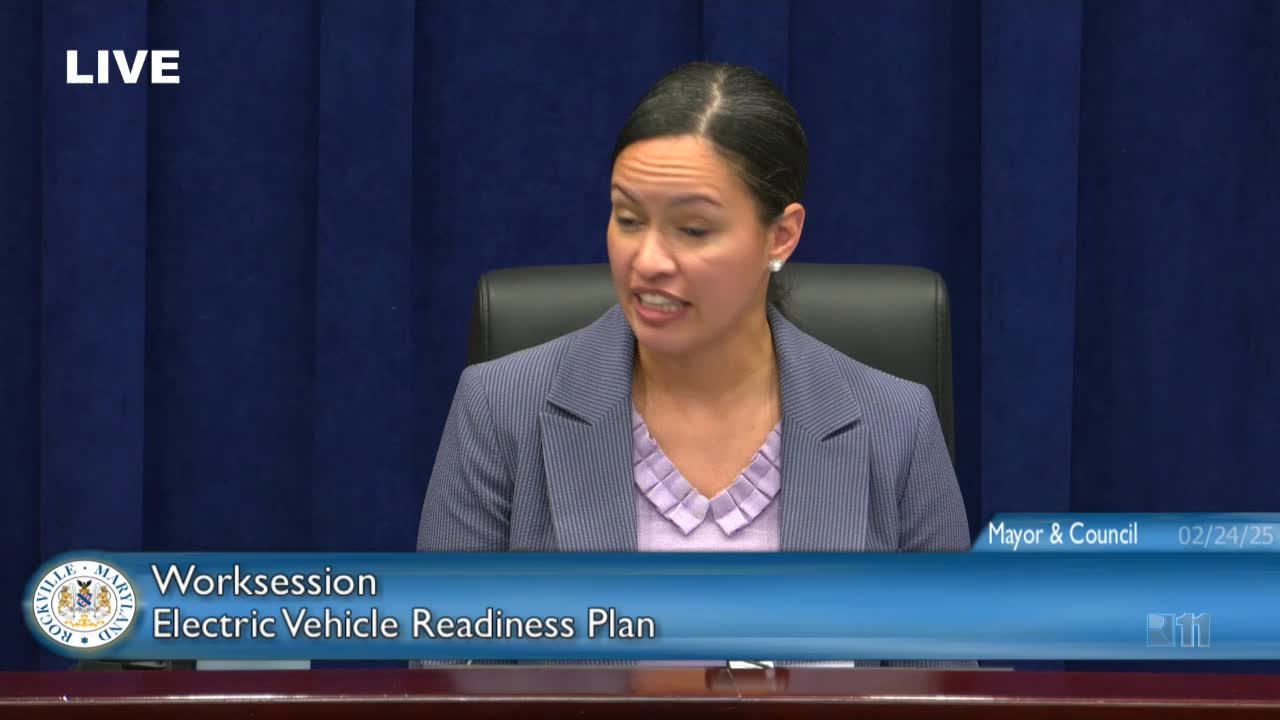
City staff presented an Electric Vehicle Readiness Plan on Feb. 24 that lays out four goals and 26 actions to expand EV charging, align codes and electrify the municipal fleet; Council provided targeted feedback on installation models, accessibility and pricing.
City staff presented Rockville’s Electric Vehicle (EV) Readiness Plan during a Feb. 24 work session, outlining four goals—code and policy alignment, a robust and equitable charging network, municipal fleet electrification, and inclusive public engagement—and 26 actions to guide implementation.
Amanda Campbell and Erica (city staff) summarized the assessment done with consultant ICF, which included an inventory of existing chargers, a crowd-sourced map of community-identified charging gaps, projections of EV registrations and port needs, and analysis of regulatory and permitting changes needed to streamline installations. Staff noted immediate actions already underway: five city-hosted level 2 ports provided through a partnership with Pepco; two sites funded and in design through Maryland Energy Administration; and several additional sites identified for future partnerships.
The plan distinguishes charging needs by location: home (single-family, multi-family), workplace, destination (shops, recreation), and DC fast chargers for longer trips. The consultant projected a substantial increase in EV registrations by 2030 across scenarios and estimated the city will need multiples more Level 2 ports and additional DC fast chargers to serve residents, workers and visitors.
Staff presented three policy questions for Council feedback: (1) which models to allow for residents who lack private driveways (four vendor/installation options ranging from vendor-operated curbside chargers to temporary cord covers across sidewalks), (2) whether to allow flexibility in parking minimums for retrofits that enable accessible EV charging aisles, and (3) what pricing philosophy the city should adopt for city-hosted chargers (no fee, cost recovery, or revenue generation).
Council feedback: Councilmembers strongly supported vendor-installed public chargers (the model used with Pepco) and were broadly favorable to the flush-conduit design (option 3) that embeds conduit in sidewalks, provided ADA and safety standards are strictly enforced. They expressed unanimous concern about model 4—temporary sidewalk cord covers—citing trip hazards and accessibility risks for walkers, people with mobility devices and those with vision impairments. Members emphasized that private-property solutions and driveway aprons remain preferred when feasible and that staff should streamline permitting for driveway aprons and private installations.
On parking minimums and accessibility, councilmembers supported flexibility for retrofits that create accessible charging aisles when practical, while acknowledging that some retrofit sites lack space and would trigger other regulatory requirements. On pricing, Council favored a mixed, location-based approach: cost recovery for overnight/residential and many multi-family sites and revenue-generation or higher fees (to encourage turnover) in high-demand destination locations such as civic centers, rec centers or retail hubs. Several councilmembers recommended starting with cost recovery and evolving pricing as usage and demand data become available.
Staff said the plan will return to the Mayor and Council on March 24 for potential adoption after incorporating council feedback. Staff also committed to produce detailed design and permitting guidance, coordinate with Montgomery County, Pepco and state programs, and continue outreach to multifamily property owners, HOAs and faith-based organizations to identify public and private charging opportunities.
The Mayor and Council praised the outreach approach, recommended continued attention to equity and accessibility, and directed staff to refine implementation guidance and pricing approaches based on the meeting feedback.