Get Full Government Meeting Transcripts, Videos, & Alerts Forever!
Get email alerts on the Pet Store Ordinance topic
No spam. Unsubscribe anytime.
Oak Grove council tables pet‑store ordinance pending clearer definitions
Summary
The Oak Grove City Council on Feb. 24 tabled an ordinance that would restrict the sale of commercially bred pets at retail pet stores, sending it back to staff for clearer language to avoid impacting home-based or ethical breeders.
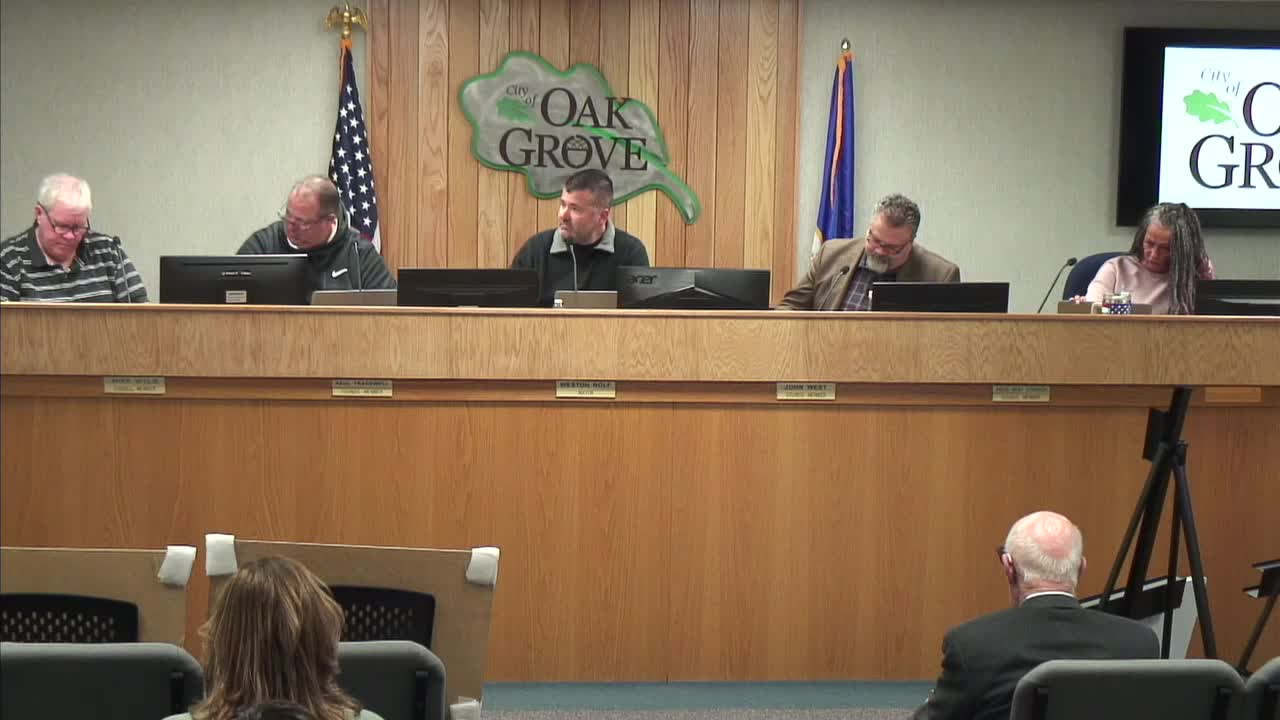
The Oak Grove City Council on Feb. 24 voted to table consideration of Ordinance 2025‑01, the draft "human pet store" ordinance that would limit retail sales of commercially bred dogs and other animals until staff returns with clarified definitions and exemptions.
Supporters and opponents of the draft spoke during a public hearing. Kathy Coughlin of Oak Grove told the council she "strongly support[s] this, and I hope you all vote for it," saying the ordinance would help prevent "bad actors" and puppy‑mill sourcing. Aaron Zellehofer of Humane World for Animals told the council the draft would not affect what he called "ethical breeders" who allow prospective owners to meet animals in person: "People that are doing that are known as ethical breeders that allow people to come in, see the dogs, see the place where they're coming from." He said, based on records in neighboring states, the pet‑store supply chain is dominated by large commercial breeders that have produced regulatory violations.
Fred Johnson, chair of the Planning Commission, urged the council to remove ambiguity in the ordinance so it would not complicate the review of interim or conditional use permits for home‑based breeders. "Taking a beat and getting it right so that those who happen to have a litter don't wonder, what do I do?" he said.
Council members raised similar concerns about unintended effects on residents who occasionally sell a litter from a home. The draft ordinance did not specifically list an exemption for ethical or small‑scale breeders, and the council asked staff and the city attorney to refine the definition of "pet store" (for example, to clarify whether the term applies only to brick‑and‑mortar commercial storefronts).
Council Member West moved to table the ordinance so the city attorney could incorporate clarifying language; the motion was seconded and carried on a 3‑2 vote. The council indicated its intent to return to the ordinance at the next meeting with revised language; the city attorney told members she expected to have a revised draft ready in about two weeks and that the planning commission would see the revision before new interim use or conditional use permit applications would be considered.
The action does not deny the ordinance; it pauses council action while staff prepares more precise definitions and explicit exemptions for noncommercial breeders. The council discussion and public testimony emphasized preventing large‑scale commercial puppy mills while avoiding criminalization or unintended penalties for residents with occasional litters or small, in‑home breeders.
The council also instructed staff to accept and consider written feedback from residents prior to the next reading and to coordinate with the planning commission to ensure consistency with existing land‑use definitions.