Get AI Briefings, Transcripts & Alerts on Local & National Government Meetings — Forever.
Tennessee Department of Revenue outlines vehicle sales-tax exemptions for military service members
Loading...
Summary
State revenue officials explained who qualifies for Tennessee sales-tax exemptions on vehicles and related tax breaks for service members, what documents clerks and dealers should accept, and how to request refunds when exemptions were missed at purchase.
Billy Trout, manager of taxpayer education for the Tennessee Department of Revenue, opened a Feb. 25 webinar by saying, "This is Billy Trout, a manager of taxpayer education for the Tennessee Department of Revenue," and welcoming attendees to a briefing on "tax issues or tax exemptions for our military service members."
The presentation summarized Tennessee rules for sales-tax exemptions on motor vehicles and related exemptions for military and certain veteran populations, explained which documents county clerks and dealers should accept as proof of stationing, and outlined steps service members should take if an exemption was not claimed at the time of purchase. "All this information is good as of today, 02/25/2025," Katie Julian, webinar specialist in the Department's taxpayer education section, reminded attendees.
Why it matters: The exemptions can affect purchases by active-duty service members, members of the Tennessee National Guard under certain conditions, and disabled veterans. Department staff emphasized that misunderstandings about orders and documentation are common, and urged clerks, dealers and service members to verify paperwork in advance or submit copies to the department for review. "If you ever have a question, whether, a purchases is exempt, please send us a set of orders," Lisette Herron, a supervisor in taxpayer services, said.
What the department told attendees: The webinar listed specific vehicle types that may be exempt from Tennessee sales tax when purchased by qualifying service members, including automobiles, trucks, motorcycles, off-highway vehicles, campers and mobile homes that meet size/permanency exceptions. It noted that leased vehicles, semi trucks, boats and ordinary trailers do not qualify.
Officials laid out who may qualify: active members of U.S. uniformed services "stationed under orders in Tennessee," members of the Tennessee National Guard or reserve members who are participants in the AGR (Active Guard/Reserve) program and stationed in Tennessee, and reservists called to active military service and stationed in a combat zone (with an IRS-regulated combat-zone list used for that determination). The department also said disabled veterans may qualify for separate adaptive-equipment exemptions or a Veterans Affairs automobile grant in limited situations.
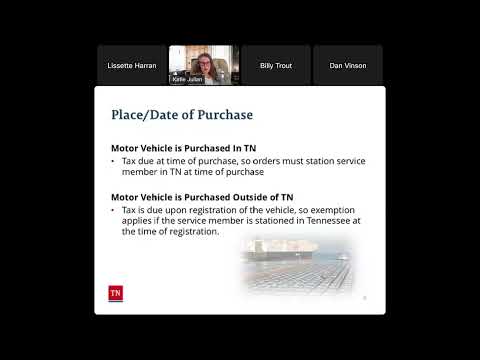
Documentation and timing: Presenters described the documents clerks and dealers commonly accept, including PCS (permanent change of station) orders and a variety of other official military orders. Herron urged examiners to "look for those keywords. Right? Title 10, AGR," to identify active-duty status. The department explained that whether tax is due at purchase or at registration depends on where and when the purchase and registration occur: if a motor vehicle is bought in Tennessee, the purchaser must be stationed in Tennessee at the time of purchase; if bought out of state, the purchaser must be stationed in Tennessee at the time of registration.
The webinar stressed nuances: a purchase made in Tennessee before a service member is officially stationed there does not qualify even if the member later registers the vehicle in Tennessee; conversely, a purchase made while officially stationed in Tennessee may remain exempt even if the member's orders later expire. For reservists activated and stationed in a combat zone, the exemption can continue for 90 days after the effective date of orders releasing the member from the combat zone.
How clerks and dealers should handle mistakes: If an exemption was not applied at the point of sale, officials said the dealer can adjust its sales-tax return for the period and refund the tax to the buyer when documentation is provided. If adjustment through the dealer or county clerk is not possible, the buyer may file a claim for refund with the Department of Revenue and submit supporting documents. "If the dealer agrees, the dealer can go ahead and adjust their sales tax return for that current period," Billy Trout said.
Other exemptions discussed: The department reviewed (1) an automobile adaptive-equipment sales-tax exemption for certain honorably discharged disabled veterans who meet statutory service-connected disability requirements, and (2) a limited Veterans Affairs automobile grant exemption that may exempt the portion of the purchase price covered by the VA grant (the department noted the VA form required for that process). It also covered non-vehicle tax items: the professional privilege tax (pro fee) is waived for active U.S. military members who served more than 180 days in the year prior to the June 1 due date if supported annually by orders, and a narrow business-tax exemption may apply to disabled veterans meeting specific asset and residency tests.
Follow-up and contact information: Presenters repeatedly urged attendees to email copies of orders for review at revenue.support@TN.gov or to call (615) 253-0600. "Send us a copy of those orders," Katie Julian said. "Most most likely it'll be Lisette or someone in her group that's looking at those, the experts here to to make sure you, are are getting what you need there."
The webinar included guidance for county clerks and automobile dealers who encounter hard-to-read orders and emphasized that the department's military tax manual and legislative summaries (updated periodically) are the authoritative sources for current law. The session closed with links to the department's webinar library and upcoming presentations on business tax and other topics.