Get Full Government Meeting Transcripts, Videos, & Alerts Forever!
Get email alerts on the Short Term Rentals topic
No spam. Unsubscribe anytime.
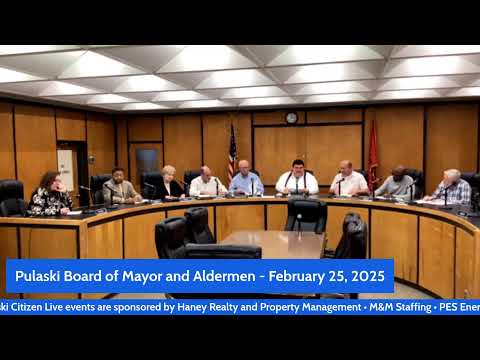
Pulaski aldermen pass short-term rental ordinance on first reading
Summary
The Pulaski Board of Mayor and Aldermen voted to adopt a short-term rental registration ordinance on first reading Feb. 25, creating a registry, requiring business licenses and hotel-motel tax collection, and defining short-term rentals as stays under 30 days.
The Pulaski Board of Mayor and Aldermen voted on first reading Feb. 25 to adopt an ordinance to register and regulate short-term rental units, requiring operators to hold a business license and to remit hotel-motel tax where applicable.
The ordinance, developed by the city planning commission and drafted with input from aldermen, is intended to create a registry that identifies short-term rental operators and a local contact for complaints or enforcement. City presenters said the measure treats short-term rentals as residential units for fire and building classification and ties compliance to existing licensing and tax requirements.
Planning commission members and aldermen said the draft was compiled after several months of review and comparison to state law and ordinances used in other cities. The ordinance’s stated objectives are registration, assurance that operators have appropriate business licenses, and collection of hotel-motel tax where the law requires it.
During the council discussion an attendee who identified himself as a landlord described a common scenario in which owners occasionally rent a unit for a few months during a vacancy, and asked whether that would be covered. A city speaker clarified that the ordinance applies to stays of less than 30 days and that a written lease of 30 days or longer would not be treated as a short-term rental even if the tenant subsequently leaves earlier.
Council members also noted the ordinance covers rentals of portions of a home (for example, a single bedroom) and cited the growth of platforms such as Airbnb as a local example. The ordinance establishes a local registry so neighbors and city officials can identify who is responsible for a given short-term rental.
A motion to adopt the ordinance on first reading was made and seconded; a roll-call vote was taken and the motion passed on first reading. The roll-call produced at least one dissenting vote; the transcript does not provide a complete numerical tally in a single line, so specific counts beyond the majority outcome are not specified in the record provided.
The board set a public hearing date for March 11 at 12:05 p.m. on a related municipal-court ordinance item that appears elsewhere on the agenda. The short-term rental ordinance will return for a subsequent reading as required by local procedure.
Speakers during the item included Harrison, who introduced the item for the planning commission’s work; Mister Keith, who moved the ordinance; Missus Miles, who seconded the motion; and several aldermen and community members who asked questions about definitions and enforcement.