Get Full Government Meeting Transcripts, Videos, & Alerts Forever!
Get email alerts on the Education Funding topic
No spam. Unsubscribe anytime.
State auditors report $ hundreds of millions in gaps for 20 Kentucky school projects; one project flagged as ineligible under HB 6 criteria
Summary
Office of the State Auditor and contractor Blue & Co. presented an audit of the School Facilities Assistance Fund showing funding gaps for 20 projects across Kentucky, with several districts reporting zero gap after local funding or scope changes; one Washington County project was flagged as failing eligibility criteria under House Bill 6.
The House Budget Review Subcommittee on Primary and Secondary Education Workforce Development heard a presentation on the School Facilities Assistance Fund audit showing identified funding gaps for 20 school construction and renovation projects across Kentucky.
Lauren Ferguson, chief of staff for State Auditor Lisonbee Ball, told the committee the auditor—s office contracted Blue & Co. to perform agreed-upon procedures required by the budget bill and that the office certified and transmitted the final report to the Legislative Research Commission. "This is not our assertion of what the schools should or should not get; it's just simply testing the criteria that's outlined in the bill," Ferguson said.
The audit applied criteria set out in House Bill 6, including project priority, project type (for example, athletic facility), whether the project had a BG number signed by the Kentucky Department of Education (KDE) and whether a local nickel tax had been levied. Using that framework, Blue & Co. calculated a current gap for each project based on submitted district information and available local resources.
The report lists substantial gaps for several districts. The largest identified current gaps include Johnson County at about $78,000,000, Bardstown Independent at about $43,000,000, Harrison County at $50,600,000 and Adair County at about $7,600,000. Other notable findings included Fleming County with a gap near $15,000,000; Garrett County near $14,900,000; Marion County near $19,700,000; Somerset Independent near $11,700,000; Powell County near $5,900,000; and Williamstown Independent with an identified need near $7,400,000. Several smaller items were also listed (for example, Augusta Independent estimated at about $5,300,000 and Walton-Verona listed at $48,000). For some districts the audit found a zero current gap: Wayne County and Woodford County were listed with a $0 current gap in the auditors— analysis.
The auditors also noted two districts that were not evaluated for additional funding after local developments: Breathitt County—s project had been fully funded prior to the audit, and Crittenden County asked to be removed from the review after it reduced project scope and determined local funding was sufficient.
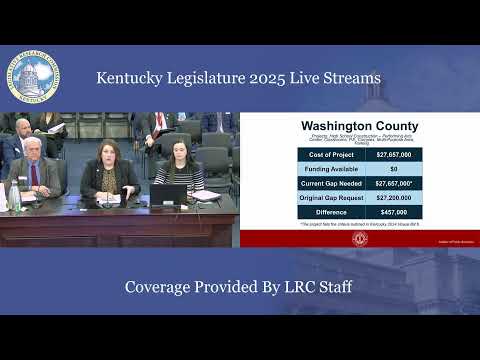
The audit flagged Washington County—s projects as an outlier: Blue & Co. recorded a calculated current gap of about $27,600,000, but the report notes that the project failed some eligibility criteria outlined in House Bill 6 and therefore may not qualify under that law—s standards for School Facilities Assistance Fund awards.
Representative Klein asked whether districts that secured local funding on their own would be penalized in the audit—s calculations. Ferguson replied that multiple factors changed gaps over time, including project cost increases and districts finding additional funding. She said auditors were directed by the budget bill to assess "local funding available" and that auditors were not asked to determine whether districts had specifically earmarked local dollars for different projects.
Ferguson and Blue & Co. representatives offered to provide the committee with the slides summarizing each school—s math and said staff could follow up with any additional questions. The Office of the State Auditor certified the report and transmitted it to the Legislative Research Commission, as required by the budget bill.
The committee recorded two routine motions during the meeting: a motion to approve minutes from the first meeting, which the chair announced had been approved by voice vote, and a later motion to adjourn for which a vote is not recorded in the transcript.
The presentation and the report provide the legislature a detailed, criteria-based accounting of local resources and calculated gaps that members may use in considering any further appropriations or policy changes connected to the School Facilities Assistance Fund.