Get Full Government Meeting Transcripts, Videos, & Alerts Forever!
Get email alerts on the Pensions Investment Policy topic
No spam. Unsubscribe anytime.
House Revenue Committee advances SF38 to switch investment pay calculation from arithmetic to geometric mean
Summary
The House Revenue Committee on a 9-0 roll call on Senate File 38 voted to advance a bill that changes how multi‑period investment returns are calculated for performance compensation at the State Treasurer’s Office and the Wyoming Retirement System (WRS), moving from an arithmetic mean to a geometric mean beginning in fiscal 2026 with a two‑year lookback.
The House Revenue Committee on a 9-0 roll call on Senate File 38 voted to advance a bill that changes how multi‑period investment returns are calculated for performance compensation at the State Treasurer’s Office and the Wyoming Retirement System (WRS), moving from an arithmetic mean to a geometric mean beginning in fiscal 2026 with a two‑year lookback.
Supporters told the committee the geometric mean is the industry standard for measuring compounded investment returns and better captures volatility over multiple periods, while officials said the change would be marginal in fiscal impact. The committee vote was taken after public comments and presentations from WRS and the treasurer’s office.
Representative Larson, who presented the bill’s history, said the performance compensation program began after the state shifted more investment management in‑house around 2015–2016 and that the program allowed investment teams to share up to 2% of excess returns subject to caps. "When we set up both plans, they were both set up with arithmetic. But now you can see in the bill ... we finish out the arithmetic through the end of 2025 and then we switch over to the geometric," Representative Larson said.
Rachel Meeker, deputy director for the Wyoming Retirement System, told the committee WRS’s investment team "significantly outperformed its benchmarks over the past three years, adding $377,000,000 in value." Meeker said the amount earned under the plan for 2024 was $957,960 ("representing 0.25% of added value") and that the actual 2024 payout was $239,490, noting that vesting rules spread payments over three years.
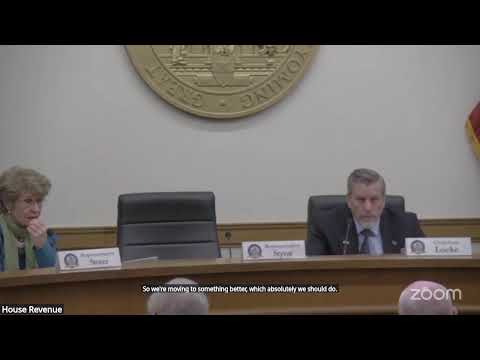
Norman LeBlanc, chief operating officer for the State Treasurer’s Office, said the treasurer’s office supports the bill as a "marginal improvement" that moves calculations toward market standards. "This is a bill that is acceptable to the State Treasurer's Office ... we're moving to something better, which absolutely we should do," LeBlanc said, while stressing that prior payouts and calculation practices were "correct" and that consultants ran Monte Carlo simulations in their review.
Committee members asked whether geometric averaging is less transparent than arithmetic, whether it better captures upside and downside volatility, and how the proposed switch treats prior periods. Representative Lane asked about transparency; Representative Larson and Meeker replied that one method is not meaningfully more transparent than the other and that geometric is the industry standard. Representative Storer asked whether geometric captures volatility better; Larson and Meeker answered that it does and suggested committee members also ask the consultants for technical details.
Members also sought clarification on timing. The bill sets a transition so returns through fiscal 2022–2025 will remain calculated with the arithmetic mean, and starting in fiscal 2026 the formula will use the geometric mean and will "reach back" to include the two immediately preceding fiscal years when applying the new method. Representative Larson explained the reach‑back is intended so the new calculation can be applied to a multi‑year period rather than beginning anew in 2026.
The bill drew no amendments during the committee session. Representative Storer moved the bill; no second was recorded in the transcript. The committee clerk called a roll call vote on Senate File 38; the recorded votes were: Representative Brown (aye); Representative Campbell (aye); Representative Lean (aye); Representative Lucas (aye); Representative Riggins (aye); Representative Storer (aye); Representative Stybar (absentee vote, aye); Representative Wharf (absentee vote, aye); Chairman Locke (aye). The committee reported 9 ayes and advanced the bill to the floor.
The presenters said oversight and benchmarks will continue to be set through existing governance: WRS board input and consultants, and for the treasurer’s office the proposal process includes the investment consultant, the independent Investment Funds Committee, and final approval by the State Loan and Investment Board (SLIB). Meeker noted WRS’s statutory reporting obligation to submit the annual performance compensation update to the Joint Appropriations Committee and Committee on Capital Financing by Nov. 1, which provided background for the proposed change.
What remains pending is floor consideration of SF38 and any technical questions the legislature's fiscal or investment consultants might raise in subsequent debate. The committee record shows proponents framed the change as aligning Wyoming’s practice with private‑sector norms and as unlikely to produce major budgetary effects, while officials emphasized the change is an incremental technical improvement rather than a substantive policy overhaul.