Get Full Government Meeting Transcripts, Videos, & Alerts Forever!
Get email alerts on the Second Amendment Protection topic
No spam. Unsubscribe anytime.
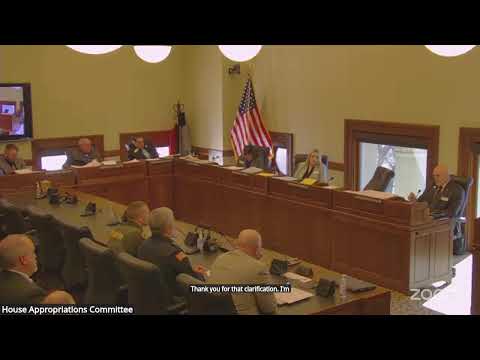
Appropriations committee debates Second Amendment Protection Act amendments; law enforcement raises task‑force, liability and tribal‑jurisdiction concerns
Summary
The House Appropriations Committee heard extended testimony on Senate File 196, a package of amendments to Wyoming's Second Amendment Preservation Act that would bar state and local enforcement of certain federal firearm laws and impose agency-level civil penalties.
The House Appropriations Committee heard extended testimony and questions on Senate File 196, an amendment package to Wyoming's Second Amendment Preservation Act (SAPA) that would prohibit state and local government entities from enforcing, or assisting in enforcement of, certain federal firearm regulations and would impose civil penalties on agencies that do so.
Senator Salazar, who brought the bill to the committee, told lawmakers the measure “prohibits Wyoming government entities from using state funds or resources to enforce federal firearm laws that violate Wyoming law” and that it seeks to “ensure that state resources are not used to enforce federal gun control measures that infringe on second amendment rights in Wyoming.” He and other supporters said the bill updates and strengthens the state SAPA law passed in 2022.
Aaron Doerr, testifying on behalf of Wyoming Gun Owners, described the bill as clarifying and strengthening the earlier law. He walked the committee through major changes in the draft: broadening the prohibition so federal task forces cannot circumvent state funding limits, removing the undefined phrase “unconstitutional” in favor of clearer language that bars enforcement of “any federal acts, laws, treaties, orders, rules, and regulations” on firearms, adding "peace officer" to the statute's definitions and — the highest-profile change — establishing civil penalties of $50,000 per violation assessed against agencies or political subdivisions rather than against individual officers.
Supporters emphasized carve-outs in the draft that would allow state officers to assist federal authorities in investigations that have a clear nexus outside Wyoming or which involve serious felony crimes, and language clarifying that Wyoming agencies may receive federal assistance and funds to enforce the laws of the state itself.
Law enforcement organizations and individual law-enforcement witnesses said they shared the bill’s goal of protecting constitutional rights but urged textual changes to prevent unintended consequences. Alan Thompson, executive director of the Wyoming Association of Sheriffs and Chiefs of Police (WASKCP), said the draft is not always clear in practice and cautioned that everyday policing frequently involves overlapping federal and state issues; he urged clearer drafting so officers do not face criminal exposure or agencies undue civil liability for routine cooperation.
Captain David James of the Cheyenne Police Department warned that the bill as drafted could chill participation in multiagency federal task forces such as DEA and U.S. Marshals task forces. He noted that officers assigned to task forces are often sworn as federal task-force officers under memoranda of understanding and that the federal indictment or charging decision — which officers do not control — could later attach a federal firearms charge. “If it's arguably going to put us at liability to be part of these task forces because we don't have control on how the attorney or the U.S. Attorney prosecutes these people,” he testified, “we just we won't cooperate.”
Lieutenant Colonel Carl Germaine of the Wyoming Highway Patrol raised a related concern involving Bureau of Indian Affairs (BIA) cross‑jurisdictional enforcement. He explained that BIA certification allows state troopers to enforce law on tribal members on certain corridors; without that certification, state officers cannot apply Wyoming law in those interactions. He said the current draft could make officers hesitant to take on required federal certifications or to act in situations where federal and state law enforcement intersect.
Committee members pressed both bill supporters and legal staff on several drafting points. They discussed where the word "solely" should apply in the statute (to the act of enforcing or to the universe of federal laws referenced), whether the civil penalties would create a pathway for large numbers of suits (for example by incarcerated people), and whether the bill as written preserves state ability to detain on state charges even when federal prosecutions follow. Committee legal counsel said the criminal penalties in some lines are existing law retained for compliance; others said a severability clause and careful word placement could reduce the risk of a successful federal challenge.
Witnesses cited litigation history in other states as relevant background. Committee counsel and witnesses referenced the Eighth Circuit decision that struck down a similar Missouri statute in 2021; they discussed efforts in the draft to remove language that courts found problematic and noted the role of the Supremacy Clause and federal‑court standing doctrines in shaping possible challenges. Committee members also discussed that private civil‑rights suits under 42 U.S.C. § 1983 ("1983 claims") remain a route for redress against officers and agencies for constitutional violations.
No final committee vote was taken on Senate File 196 at the hearing. The chair said the committee would continue the bill at the next scheduled meeting (the noon recess on Wednesday) to allow more drafting fixes and additional testimony from legal staff and stakeholders.